
Hearing and Doing: The Speeches in Acts and the Essence of Christianity
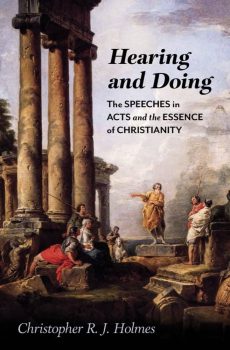
Christopher R. J. Holmes, Hearing and Doing: The Speeches in Acts and the Essence of Christianity (Waco, TX: Baylor University Press, 2022). US $42.99, Hardcover.
Two stories warrant attention. First, the story of modern theology in the Christian West has involved the increasingly frequent detachment of systematic theology from the work of biblical exegesis. Whether by reference to existentialist philosophy or cultural theory or political activism, theologians have been known to cease speaking the language of the Bible and no longer view themselves, first and foremost, as offering analytic commentary on the text of Holy Scripture. Happily, there have remained many exceptions to this rule, though mainline institutions have been marked by its scale and severity. The bifurcation of gatherings at the supposedly joint meetings of the American Academy of Religion and the Society of Biblical Literature are a manifestation of this ongoing detachment among so many.
Second, there’s been a common telling of early Christian history (at least since the time of F. C. Baur and, soon thereafter, Adolf Harnack) that distinguishes the earliest phase of the Christian movement from a later catholicizing phase. Many implications follow, but one is that early Christian proclamation was viewed as being morally serious, metaphysically disinterested, and confessionally or creedally diverse. Those metaphysical and creedal concerns would only arise later, in reaction to social pressures. In so doing, many viewed them as a declension from a simpler, freer nascent Christianity. So goes the typical story of the Hellenization of early Christianity. This myth persists, though historians of Christianity in late antiquity continue to illumine its limitations and flaws.
Christopher Holmes’s Hearing and Doing dispels both of these modern tales at once. His book examines the Acts of the Apostles, seeking to reveal the metaphysical and moral integrity of early Christian proclamation. Holmes looks to the speeches of Acts as a window into early Christian proclamation, considering a range of thematic studies: mercy of God, grace of Christ, hope of the Spirit, invocation of God, fear of God, and heavenly instruction. In so doing he also registers ways in which that proclamation has been formative for and interpreted by later thinkers. John Calvin and Thomas Aquinas are guiding lights exegetically and metaphysically, while Kate Sonderegger and Rowan Williams are contemporary interlocutors of repeated significance. It’s a book that models attention to theological claims old and new, finding treasure repeatedly in both.
It’s also a book willing to accent something afresh. One area where Holmes seeks to contribute above and beyond the work of Sonderegger and Williams regards his emphasis upon the need for language more active than merely participatory language. Creaturely participation involves sharing in God’s life, by God’s grace, in such a way that humans really have moral and volitional integrity, responsibility, and agency. Holmes seeks to supplement the compatibilist approach of Sonderegger by insisting on injecting active verbs with human subjects (20; see also 173 ns. 43-44). Now, one might wonder if this is an effort to make an end run around the truly participatory and dependent character of humanity or, otherwise put, the completely sufficient generosity of God in giving life to his creatures. I do not believe that Holmes falls into such an error. His account orients itself repeatedly not only to the mercy, grace, and hope that only God gives, but he also shows that the moral life itself – that human agency that involves humans being subject to a host of active verbs – also finds orientation in invoking God in prayer, in fearing God as Lord, and in being mindful of God’s heavenly life. Holmes warns us against the danger of believing that participatory language is sufficient to describe the Christian life, though it surely plays a necessary role in describing its inception in God’s mercy and its progress through union with God in Christ.
The early Christian proclamation expounded by Holmes herein includes metaphysical, proto-creedal claims. They are prompted by experience of the wonders of God, by his mercy displayed, his grace given, his hope communicated, but they are truly metaphysical teachings. Then and only then does moral teaching transpire. Holmes shifts herein from the voice of Peter to that of Paul, seeking to show the way in which they are harmonized, not competitive, even as he shows that the moral address of Paul (not least on matters of Jews and Gentiles and the revitalization of social norms in an increasingly catholic ecclesial community) follows from and finds its footing in the metaphysical claims which overlap with the earlier Petrine sermons.
The book has a healthy smattering of endnotes that include note only references but some particularly thoughtful elaborations (161 n. 20, 160-161 n. 23). The book’s only significant fault, if it be one, is that too much that it’s doing remains implicit. The text does not name these two modern stories (about theology separated from exegesis and about a non-metaphysical early Christianity later turned creedal and ontological) and the ways in which it, the text, is simultaneously disproving the both of them. But I suppose that literary caution – humility? – is a curious vice to identify. It’s hard to be frustrated with the text understating its challenges and its achievements.
The contemporary theological scene has fractured. There are still plenty supposed theologies which do little to show concern for scriptural language and interpretation. Yet be a wave of theologians has committed itself afresh to the role of Bible in the task of theology. Holmes claims that “If Scripture is theology’s source, its ongoing food, and its perennial delight, then there is a strong argument to be made for pursuing the systematic task in an almost commentarial mode” (156). In truth, Christopher Holmes has offered a sequence of studies that engage doctrinal topics by way of reflecting on a subsection of Scripture, whether it’s the Farewell Discourse’s implications for understanding Ethics in the Presence of Christ (London: T & T Clark, 2012) or the Psalms invitation to contemplate how The Lord Is Good (Studies in Christian Doctrine and Scripture; Downers Grove, IL: IVP Academic, 2018). To these wonderful studies, one can now add this remarkable little book on the speeches in Acts.
Michael Allen
Reformed Theological Seminary, Orlando
