
Empowered Witness: Politics, Culture, and the Spiritual Mission of the Church
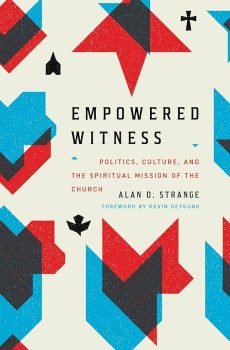
Alan D. Strange, Empowered Witness: Politics, Culture, and the Spiritual Mission of the Church. Wheaton: Crossway, 2024. $16.99, paperback.
2024 is a polarizing election year in America. Widely divergent political visions strive for cultural dominance. To be sure, claims about the breadth of the division are frequently overwrought and untrue. Today’s situation is not comparable to the fissures that cracked the foundation of society in antebellum America, fault lines that would eventually shatter national unity and lead to civil war. Still, contemporary forces on the political right and left compete vigorously for adherents among the electorate. The church is not exempt from cultural turmoil. Many congregations are deeply divided both over political issues and the question of how (if at all) their churches should respond to them.
Pastors attempting to navigate their churches through these troubled waters need mature and historically informed leaders who have thought deeply about the relationship between church and politics. Alan Strange is one such voice. His Empowered Witness helpfully reacquaints contemporary believers with the doctrine of the spirituality of the church.
A fresh look at the doctrine is certainly needed. Often it is rejected out of hand as a theological tool to bar the church from taking positions on weighty and controversial moral issues — a doctrinal cover for Christians advocating slavery in the 19th century, as well as massive Southern resistance to civil rights legislation in the 20th. The doctrine’s detractors claim it presents a privatized faith that leaves the nation bereft of the church’s prophetic witness and call to repentance.
The author is not without sympathy for these concerns. Nevertheless, he offers a spirited defense of the doctrine. Building upon his previous work in this area (The Doctrine of the Spirituality of the Church in the Ecclesiology Charles Hodge, 2017), Strange explores Hodge’s articulation of the doctrine of the spirituality of the church within the context of the greatest political and moral question of the 19th century, namely, race-based chattel slavery. After defining the doctrine (chapter 1), he discusses the doctrine’s adherents, their varying and, at times, conflicting understandings of it, and debates over it in the courts of the Presbyterian church before, during, and after the Civil War (chapters 2-5). Finally, he argues for the continuing relevance of the doctrine in the life of the church (chapter 6).
Studying this doctrine through the writings of Charles Hodge has several advantages. Princeton Theological Seminary, where Hodge taught, was the most prominent Presbyterian institution of higher learning in the nation. For nearly six decades Hodge trained ministers there, and through them exerted a national influence that extended far beyond his own ecclesiastical communion.
Hodge’s breadth of learning, knowledge of scripture, theological acumen, and clear writing commanded widespread respect, even from those who found themselves at odds with him on various issues. An informed interest in politics led to his wrestling with the relationship between politics, governmental policy, and the church. His participation in the courts of the church began as the slavery controversy heated up in the 1820’s and continued for more than a decade after the Civil War, a period that witnessed the increasing politicization of the northern Presbyterian church.
Strange does not write as a detached commentator on church life. At the outset, he defines his own position: “The calling, or mission, of the church as the church is to proclaim the gospel to the ends of the earth, not to be another merely (or even chiefly) political, social, or economic institution. The church, in its full-orbed existence, may have political, economic, or social concerns that develop out of its mission, but those aspects are not what primarily mark and define it.” (1) He calls on all Protestant to embrace the “mere spirituality of the church” (11). By mere spirituality, the author means that the church as an institution, has a spiritual mission that only it can fulfill (15). The burden of author can be summed up in a single sentence: “Let the church be the church.” (6)
The author reminds readers that the church can be conceived of as an institute and as an organism. As an institute, the church’s mission is to evangelize and disciple. As an organism, the church’s members live out their faith in their various vocations, including politics. The institute errs when it undertakes to perform the responsibilities that belong to individual Christians in their personal callings (4).
Throughout the book, the author’s favorable opinion of Hodge is apparent. He writes, “I seek to demonstrate that [Hodge] developed his doctrine of the church’s spirituality in a subtle and nuanced fashion that permitted him to distinguish the church from the state and its political concerns while also allowing the church to retain a prophetic voice in society” (23). He contrasts Hodge’s moderate position with more radical proponents like James Henley Thornwell and Stuart Robinson (22).
The author’s appreciation of Hodge is not uncritical. At times his criticism is sharp. Strange reviews the work of Reformed Presbyterian Church minister Alexander McLeod. While adhering to the doctrine of the spirituality of the church, McLeod sought at the same time to demonstrate that the Bible provided no justification for slavery. In his arguments for the elimination of slavery, he pointed to texts that prohibited manstealing (Exodus 21:16, 1 Timothy 1:10), a practice foundational to American slavery. He further argued that proslavery appeals to the Ham/Canaan curse of Genesis 9:20-25 and Israel’s enslaving of enemy nations were misinterpretations of scripture; these events were unique in redemptive history and never meant to place the divine imprimatur on the institution of slavery. Finally, the realities of race-based chattel slavery cannot be reconciled to the master/servant relationship described in Colossians 4:1, one in which, according to McLeod’s paraphrase, requires that the former give the latter “that which is just and equal.” (46-50)
The author laments that Hodge and his Old School Presbyterian colleagues failed to make use of the arguments of McLeod and other Covenanters, and instead “repeated the tired nostrum, ‘The Bible does not condemn slavery, and neither can we.’” This reasoning was a sad example of “the cultural captivity of the church.” (49) The author notes that
to suggest to any White American of the time that the acceptability of slavery meant the permissibility of Whites being enslaved was unthinkable. For Americans, the only acceptable slavery was Black slavery, a conviction that by itself demonstrates how contemptible and wrong the institution of chattel slavery was.” (51)
Does the doctrine of spirituality of the church mean that it should never speak to political and civil concerns? Not at all, Strange argues. True, the church as an institute must refrain from speaking to matters of public policy that are purely political. Such restraint is consistent with Westminster Confession of Faith 31.4: “Synods and councils are to handle, or conclude nothing, but that which is ecclesiastical: and are not to intermeddle with civil affairs which concern the commonwealth, unless by way of humble petition in cases extraordinary; or, by way of advice, for satisfaction of conscience, if they be thereunto required by the civil magistrate.”
But when the church is gathered as the people of God to sit under the preaching of his word, ministers must declare the whole counsel of God. The church as an institute must address all matters of life that the Bible addresses (111). Therefore, if manstealing is forbidden by scripture — and, by good and necessary inference, the institution of slavery founded upon it — then the church must not remain silent. Likewise,
one may properly preach, as warranted by the text, that abortion is sin (or that greedy business practices, racism, same-sex marriage, oppressive exploitation, and so on are wrong) but not what precise political moves should be made to address it. To preach against sin is one thing; to preach the detailed solution to complex political questions, especially about which people of the same confession differ, is another. (11-12)
That the church’s position will prove consequential to issues of political and civil life is unavoidable, welcome, and consistent with the doctrine of the spirituality of the church as correctly understood.
Which issues to be addressed, and how and when to address them will not always be immediately clear. And mere adherence to the doctrine of the spirituality of the church will not prove decisive in such discussions. What it will do is provide a proper framework for carrying on the hard work of finding a path forward that is faithful to the church’s spiritual mission.
The author concludes,
I think that the reintroduction of this doctrine into present theological conversations can have a salubrious effect but only if we embrace what is at its heart, true spirituality, and reject its bad by-products, apathy to our world and its needs. We must not allow a simple claim that something violates the spirituality of the church to settle a matter. We must not imagine that a mere citation of “the spirituality of the church” disposes of problems. . . . Rather, we should look at every proposal on its own terms and thoughtfully apply the principle of the spirituality of the church. The spirituality of the church then could be recovered for the ongoing dialogue of how the church is to relate to the world in which it finds itself, both in how it distinguishes itself from the world and how it gives itself to the world. (127)
Today our nation and its churches are subject to deep political divisions. For some Christian leaders, the path forward is for the institutional church to be politically active on a wide range of issues, so much so that one is left to wonder if everything is political. Other leaders advocate a hands-off approach to anything that touches upon politics. Empowered Witness maps out for the church a better way – one that is faithful to the church’s spiritual mission and prophetic witness.
Charles Wingard
Reformed Theological Seminary, Jackson
