Taking Religion Seriously
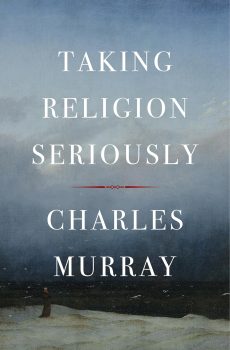 Charles Murray, Taking Religion Seriously. New York: Encounter Books, 2025. 185 pp. $29.99, hardcover.
Recent years have witnessed more than a few public figures announcing and recounting their conversions to Christianity. Perhaps the best known is Ayaan Hirsi Ali, an ex-Muslim who was formerly associated with the so-called “New Atheists.” (Her friend Richard Dawkins is still in shock.) Other converts include historian Niall Ferguson, author Paul Kingsnorth, journalist Molly Worthen, and Wikipedia co-founder Larry Sanger. Less recent and less publicized, but no less significant, is the journey to Christian faith of the political scientist Charles Murray.
Murray is currently the Hayek Emeritus Scholar at the American Enterprise Institute, a conservative think-tank, and is best known for his books Losing Ground (1984), The Bell Curve (co-authored with Richard Herrnstein; 1994), and Coming Apart (2012). His latest book, Taking Religion Seriously, is very different from his previous publications (not least in its relative brevity). It is an autobiographical account of his pilgrimage from “enlightened” skepticism to acceptance of the existence of God and the central historical claims of Christianity. It is not intended as a work of apologetics (“I don’t proselytize,” he writes) and Murray is careful to point out that he is speaking to issues beyond his areas of academic expertise. Nevertheless, the purpose of the book is to recount his intellectual journey from “happy agnostic” to Christian theist, and to make the case that, contrary to the received wisdom among the intellectual elite of Western society, there are good rational grounds for religious—specifically, Christian—beliefs.
The 160-page book is divided into two parts, “Taking God Seriously” and “Taking Christianity Seriously,” and thus it loosely follows the structure of C. S. Lewis’s apologetic in Mere Christianity. (This is not coincidental, given that Murray credits Lewis as one of the major influences on his thought.) According to the opening chapter, the journey began not with Murray himself, but with his wife, Catherine. In the months following their first child’s birth in 1985, she discovered that “her love for her daughter surpassed anything she had ever known”; indeed, it was a love “far more than evolution required” (7). This realization launched Catherine on a spiritual quest that left her husband little more than bemused. In fact, Catherine’s subsequent religious experiences led Murray to conclude that he suffers from “a perceptual deficit in spirituality” (17). He simply didn’t feel any need for religion. This was partly a matter of personality and temperament, but also, he came to realize, the result of “Western modernity” both distracting him from religious questions and shielding him from “the agonizing losses, pains, and sorrows that were part of human life since the dawn of humankind” (17–18). The road of spiritual experience was not open to him. Fortunately, as it turned out, the road of intellectual curiosity would do just as well.
Chapters 3 through 5 chart the reasoning that led Murray to accept a supernaturalist, theistic worldview. An early nudge came from noticing “the mathematical simplicity of many scientific phenomena” (22). Why does the physical universe display a striking mathematical order that can be expressed in such elegant and relatively simple formulae? “It was almost as if someone had planned it that way,” Murray reflects (23). A stronger prodding came as he began to wrestle with the age-old question, “Why is there something rather than nothing?” What surprised Murray most was how unreflective he had been hitherto, and what a crudely anthropomorphic conception of God he had been assuming.
What finally led Murray to accept the existence of God, however, was a version of the design argument. In the early 2000s, Murray read Martin Rees’s Just Six Numbers. A highly respected scientist, Rees was not a religious believer, yet his book “compelled me to accept that the universe was fine-tuned to permit life” (36). Murray concluded that there are only three viable options: (1) there is only one universe and “we lucked into an inexpressibly small chance”; (2) there are innumerable universes and thus it is no surprise that one of them (ours!) permits life to exist; (3) there is only one universe and it was designed to support life (43). Murray became convinced that the third option was the most plausible by far, at least for those not blinded by materialistic prejudices. Furthermore, his studies revealed, there is strong empirical evidence (paranormal phenomena, near-death experiences, and experiences of terminal lucidity) that consciousness cannot be explained in purely materialistic terms. Thus, in addition to the existence of God, Murray confesses, “I had to acknowledge the possibility that I have a soul” (59).
These interrelated epiphanies opened the door to giving Christianity a second look—or more accurately, a first serious look. Murray’s research for his book Human Accomplishments forced him to recognize the unique role that Christianity played in the positive development of Western culture, particularly in the sciences and the arts. Soon afterwards, C. S. Lewis entered the story, as Murray was challenged to read and critically engage with Lewis’s Mere Christianity at the prompting of a White House staffer. “Two large issues stood out,” he recalls. “What did I think of Lewis’s argument about a Moral Law that originates with God? What did I think of Lewis’s assertion that you do not have the option of saying that Jesus was a great moral teacher—that instead you are required to decide whether he was a lunatic, a liar, or the Son of God?” (75).
Reflecting on the first question, Murray became persuaded by Lewis’s argument that there is a transcendent Moral Law to which we are all subject, and that fact can best be explained by the existence of a transcendent Moral Lawgiver. In particular, Murray concluded, our instinct that altruism is morally commendable—even when the beneficiaries are not genetic relatives of the benefactors—cannot be explained on a Darwinian evolutionary basis. If Lewis’s moral argument is sound, then not only does God have a personal relationship with us, but God must himself be “ultimate Goodness” (84).
Could it be possible, then, that God loves us—even to the extent that, as the New Testament proclaims, God sent his Son into the world to give us eternal life? At this point in his journey, Murray realized he had no option but to investigate the credibility of the New Testament, especially the four Gospel accounts. Long story short: Murray “did the reading,” on both sides of the debate, and concluded that the Gospels are historically reliable sources, written only decades after the events described, and based on credible eyewitness testimony. Not only does that mean we can know what Jesus really taught; it also means we must take seriously the reports of Jesus’s miracles, and most significantly of all, the claim that Jesus was seen alive again after his public execution. In the space of several pages, Murray neatly summarizes the historical evidence for the resurrection and the shortcomings of naturalistic explanations.
The final chapter of the book ties things together by answering the “So what?” question. Murray seeks to impress upon his readers not only that there is good evidence to support the central claims of Christianity—enough to satisfy any modern intellectual—but also that it really matters, both for this life and for the next.
On the whole, Taking Religion Seriously will be an encouragement to Christian readers, while skeptics will find many of their assumptions and prejudices challenged. There are some disappointments along the way: Murray still accepts the evolutionary account of human origins, regards the birth narratives of Christ merely as “beautiful fables” (123), and makes some confused (if not unorthodox) comments about how to understand the deity of Christ (156–57).
Such blemishes aside, at least five useful lessons can be drawn from the book.
(1) Western secular intellectuals typically dismiss Christianity not because they have responsibly considered the evidence and remain unpersuaded, but because they have been preconditioned by the reigning wisdom that there are no respectable intellectual grounds for Christian beliefs. To adapt a line from G. K. Chesterton: Christianity has not been studied and found wanting; it has been found distasteful and left unstudied.
(2) In connection with the previous point: intellectual and social peer pressure plays a major role in explaining why secular academics don’t take religion more seriously. As Murray candidly admits, one reason he was so resistant to the evidence was because he belonged to “the tribe of the smart people” and didn’t want “to be thought credulous and foolish and get kicked out of the tribe” (147).
(3) The evidence of the truth of Christianity is there in abundance for those who have eyes to see it—that is, for those who are not blinkered by naturalistic presuppositions and intellectual snobbery.
(4) While philosophical and historical arguments may not be the common way people come to Christian faith, but they are nevertheless important, especially when the converts have an audience of intellectual peers. Lewis provides one such case; Murray now another. In both cases, notably, the journey involved philosophical reflection and a series of divine providences.
(5) Christian scholarship matters! Consider a selective list of the scholars whose work Murray credits with changing his mind over time: Stephen Meyer, Larry Hurtado, Paul Barnett, Richard Bauckham, Brand Pitre, Craig Blomberg, Michael Bird, Peter J. Williams, N. T. Wright, Gary Habermas, and—nota bene—RTS Professor Emeritus, Charles E. Hill. (Let the record show that Murray also consulted the works of skeptical scholars such as Brian Greene, Sean Carroll, John Dominic Crossan, and Bart Ehrman—further underscoring the importance of robust scholarship in defense of orthodox Christianity.)
The overall thesis of Taking Religion Seriously is relatively modest: anyone who approaches questions of religion with an open mind, and a scientist’s commitment to following the evidence wherever it leads, will discover that there is a serious case to be made against materialistic atheism and in favor of Christian theism. Whether any unbeliever can approach such matters with a truly open mind, apart from a work of divine grace, is not a question raised in the book. Nevertheless, Murray’s personal testimony is cause for celebration: “God’s grace has become real to me” (153). One can almost hear the angels rejoicing in heaven.
James N. Anderson
Reformed Theological Seminary, Charlotte