
Sin and the Vulnerability of Embodied Life: Towards a Catholic Account of Social Sin
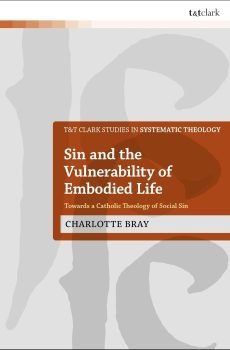
Charlotte Bray, Sin and the Vulnerability of Embodied Life: Towards a Catholic Account of Social Sin. T&T Clark Studies in Systematic Theology. London: Bloomsbury T&T Clark, 2025. 240 pp. $115.00, hardback; $39.95 paperback.
In recent decades, much has been written on the notion of “social sin,” and yet such a term eludes clear definitions—how are societies or situations “sinful”? And, if they are, how are such situations held culpable? Are not sins, properly speaking, about individual acts? Charlotte Bray’s monograph seeks to synthesize Catholic, liberation, and queer theologies to address such questions and to argue for an account of social sin that is at once socially granular and traditionally accountable.
Bray takes for granted Alistair McFayden’s distinction between a theological account of sin and a merely moralistic one—the former observes that sin is irreducible to personal culpability and is likened to a power that conditions individuals prior to individual acts of sin. Chapter one explores John Paul II’s theology of sin, and argues that, despite the deployment of “social sin” in his writings, the Pope had an individualistic account of sin. Social sin was thus only called such by analogy—individuals who freely commit themselves toward wrongdoing are properly sinners, and those sins might have social ramifications. Those social ramifications might in turn perpetuate sin. Because Pope John Paul II’s account still presupposes an individualist definition of what constitutes sin, he lacks the capacity to explain in granular ways how social structures might impinge themselves on human sinfulness. There appears, Bray argues, a retainment of a personal freedom that remains insulated from the “exterior influences” of social sin (28). One can freely acquiesce to those influences or resist them. The reason the Pope emphasizes this moralistic understanding of sin is due to the worry that Latin American liberation theologians have conceived of sin in solely social terms, thus eclipsing personal moral responsibility. To the contrary, and drawing from the natural law tradition, the Pope had argued that humans always had the capacity to discern good and evil apart from social conditions, and, through the presence of Christ with the world, all were thus enabled to resist sin (46–9).
What emerges from Bray’s analysis of John Paul II are two issues: the Pope seems only to affirm social sin in an analogous sense (and reduces it to the social ramifications of individual sins) and is unclear on the ways in which social contexts condition human sinfulness. A Catholic account of social sin, however, should not only address these two issues, but remain faithful to John Paul II’s emphases on personal responsibility, the human capacity to resist sin, and sacramental reconciliation (52). In chapters two and three, Bray then turns to the writings of liberation theology (as represented by Jon Sobrino, Ignacio Ellacuria, and José Ignacio González Faus) and Thomas Aquinas and the Council of Trent, respectively, to flesh out an alternative Catholic theology of social sin. In chapter two, Bray observes that these liberation theologians argue that the experience of those in the margins and oppressed should be the lens through which one speaks of God and sin. Sin is thus defined as that which actively leads to death, and thus structural sins refer to those situations that lead to murder, exploitation, poverty, and are thus counter to God’s will for human flourishing, sacrificing human dignity to the idolization of particular social structures (84).
In chapter three, Bray presents Aquinas’s account of sin and corruption. Though actual sin, Thomas argues, is a personal act, it flows from a wounded nature that has lost the grace of original justice. Bray wisely shows that Thomas is difficult to interpret on the consequences of this loss—is nature left merely unto itself, such that the “disordered impulses” (ST, I-II, 82, 1, ad 3) are inevitably present in nature without supernatural grace, or is nature wounded by the privation of that grace? While Bray suggests that the latter reading is to be preferred, she acknowledges that Thomas himself is at times unclear on the matter, determined as he was to emphasize both the integral goodness of human nature after the fall and the necessity of grace to heal human nature, given original sin (114). Nonetheless, Thomas (especially in his On Evil), and the Council of Trent, regard original sin as distinct from personal sin but yet as really contracting sin. This puts their position in tension with John Paul II’s more moralistic (individualistic) account of sin, Bray argues. Bray then goes on to observe that for Thomas, the fallen human person still is inclined towards the apparent good, but he or she is now mistaken or ignorant of the true good (122; ST I-II, 77, 2). Sin is thus the inordinate desire for natural goods, and fallen humans can obtain some natural goods without grace, though they obtain these sinfully by making them ultimate. Grace is necessary for the fulfillment of the natural law and for obtaining man’s highest good: communion with the Trinity (126–7). With respect to the Council of Trent, Bray then observes that the sacraments mediate grace which allow the penitent to avoid mortal sins, though they commit venial sins (130–2).
The upshot of this lengthy chapter on Thomas and Trent is that John Paul II’s moralistic emphasis on sin stands in tension with the broader (and older) Catholic tradition, which accepts an account of sin that extends beyond individual acts, and of original sin as that which conditions human agency (137). Here then, Bray seeks to show that this older tradition is at least compatible with liberation theology’s indication that there is such a thing as social sin, given their account of sin as a state or power that conditions individuals. In the final chapter, Bray argues, however, that social sin is illumined by original sin but is not identical with it. Social sin is about the “forces and norms which underlie and sustain social structures,” which mangles the self (139).
In the fourth chapter, Bray builds on Judith Butler’s constructivist view of the self and gender. Butler argues that the self is constituted by the social and embodied contexts in which the self is found, which instills and forms that self with certain norms which the self does not choose. The norms are then internalized by the self, including gender and socioeconomic norms, and even while one tries to stand outside the “norm,” one is still defined in relation to it (149–50). It is the task of queer theology to describe the unjust norms that falsely categorize and render violence to certain classes of socially marginalized groups—such categories fail to do justice to the particularities of these groups (e.g., the poor and the LGBTQ+ community) and imposes the expectations and gaze of one particular privileged group upon them (e.g., heterosexual, middle class, etc.), effectually excluding these marginalized groups, considering them unworthy of one’s grief when tragedy befalls them (152–3). Bray thus argues that Catholic social teaching presents a “countervailing” norm that resists the harmful norms that pervade Western society (166–7). Catholic teaching is thus able to learn from queer theology. Queer theology’s insistence on the constructivist nature of the norms one takes for granted bestows granularity on the Catholic insistence that human knowledge of God and the human are beyond our grasp (168). With the insights of liberation theology, Catholic authorities are always subject to the “continuing revelation” that comes from the marginalized communities (169).
The yield of this chapter is to show that Butler’s and queer theology’s understanding of the self as socially constituted is to show in more granular ways how sin is a state under which humans exist, as much as it is an individual act. A social sin is “the all-pervasive power of historical human sinfulness to shape our very subjectivities, as well as the social structures in which we live, in ways contrary to the divine will … it depicts the power of collective human sinfulness to shape our lives in a fallen (yet graced) world in ways which distort our relations to God and one another” (191). Our natures and choices are themselves constituted by and conditioned by a prior sinful condition (196).
This monograph is well-written and creative, and the lengthy chapters on John Paul II, liberation theology, Aquinas and Trent, Butler and queer theology, make for good stand-alone essays that serve as useful expositions. Yet, it appears that the very questions that need to be addressed for the thesis to be persuasive, at least to this reviewer, are left acknowledged but unexplored. The two I have in view are (1) the questions concerning papal infallibility and the authority of Catholic tradition, given Bray’s claims concerning the continual revelation of Christ in marginalized communities, by which tradition is judged (169) and (2) the immediate tension of Bray’s deployment of queer theology with Thomas’s (and the broader Catholic) account of natural law. Both of these issues, Bray argues, are “beyond the scope” of this book (169 n. 129, 191), yet, these are precisely the immediate objections most relevant to the central argument of the book, for the broader and older Catholic tradition has a decidedly essentialist account of human nature (and gender), and thus represent the norms that are harmful, from the perspective of queer theology. Furthermore, it would have been fruitful to consider the different norms and standards that determine what constitutes “harm”—queer and liberation theology’s definitions of harm could themselves be considered socially constructed, and readers may well agree that social conditions constitute and determine human action, but those who disagree that sin is simply what is harmful to others (rather than that which is also contrary to God’s revealed natural law), would be less than persuaded by Bray’s account. In this regard, Bray’s analysis of freedom and grace in Thomas (133–4) would have been rounded off better as well by also discussing Thomas’s views on predestination, according to which God elects some to eternal life and reprobates others (ST I, 23.3). Protestant readers, too, would see more clearly the ways in which Reformed inflections on particular doctrines like sin and grace would take them on a different route than those taken by Bray (e.g., Protestants would agree that this sinful order is also a site of God’s historical grace, but would argue that this common grace is something distinct from the grace by way of sacramental mediation).
In any case, these varied prompts still show this is a worthwhile book that stirs much by way of reflection and response, and is a valuable contribution to the literature on how to think about social sin.
N. Gray Sutanto
Reformed Theological Seminary, Washington, D.C.
