
Scribal Treatment of Extra-Biblical Citations in the New Testament
Gregory R. Lanier
Professor of New Testament
Reformed Theological Seminary, Orlando
This study sits at the intersection of two well-trodden fields in New Testament (NT) scholarship—citation practices and scribal habits—but covers an aspect that has received relatively limited attention.[1] The former field focuses on citations/quotations/allusions to Israel’s Scriptures in the NT, the voluminous details of which need not be rehearsed here.[2] The latter has tended to focus on copying behaviors within the NT text (e.g., haplography, dittography, transposition, harmonization), though of late more attention has fallen on paratextual features around the text (e.g., paragraph segmentation, marginalia) as part of a broader surge of interest in early Christian material culture.[3] The two fields could be brought together by examining how scribes or editors marked what they perceived to be scriptural citations within a NT manuscript, but thus far surprisingly sparse research has probed this topic.[4] A recent article has made helpful preliminary strides in surveying how scribes might mark Old Testament (OT) excerpts in the NT,[5] so here I will turn attention to an even less-explored vein to complement this work: scribal treatment of extra-biblical materials excerpted in the NT. Such citations are interesting in their own right and receive sporadic attention by various church fathers and modern scholars. What has not been studied in any systematic way is how scribes handled them, particularly those who employ various paratextual features to mark biblical excerpts.
In what follows I will conduct a preliminary exploration of thirteen passages where the NT may directly cite potentially extra-biblical material and document how certain scribes signaled or did not signal them. As will be shown, the data collected raise interesting questions about scribal behavior—e.g., what prompts a scribe to mark an extra-biblical citation in the same way as a biblical one?—and point to several additional lines of future research. I will proceed by outlining the approach (passages, manuscripts, and scribal practices to be studied), analyzing the data for the chosen passages, and summarizing the findings.
I. Approach
Methodologically, this study is straightforward in that it simply involves direct consultation of manuscripts to catalogue how particular scribe and/or editor(s) have treated citations, if at all.[6] Delimiting the field of data is less straightforward but essential to framing what exactly this research accomplishes.
1. Passages. The first step is to identify which passages are to be studied. The hundreds of NT uses of Israel’s scriptures form too large a set to tackle in an article-length study. The use of extra-biblical material is more manageable and quite interesting in its own right. But defining the term “extra-biblical” is challenging insofar as it requires taking a stance on what constitutes “biblical” (or “canonical”). Views vary and unavoidably engage theological perspectives in order for the term “Bible” or “canon” to have any real meaning (Jewish, Protestant, Roman Catholic, Orthodox). Moreover, NT citations of predecessor works are often part of the equation for adjudicating these issues in the first place; for instance, many commentators uncritically assume Jude’s citation of 1 Enoch automatically implies that he had a broader biblical canon (Jude 14–15). This study, however, is not trying to make a claim about biblical canon in itself but is simply an exploration of a certain set of scribal data. Thus, any definition of “extra-biblical” would work heuristically so long as it is clear and consistent. For the present study, I will apply “biblical” to the traditional books in the Jewish threefold canon (Tanakh); in turn, any other cited material that falls outside those bounds—or, at least, that is not unambiguously traceable to specific books within that collection—will be labeled “extra-biblical.” Even if one were to argue that books such as the Ben Sira, Tobit, or 1 Enoch belong in the “biblical” (or “canonical”) category, establishing this fixed point is still useful insofar it helps delimit the passages that are precisely the point of contention.
I will also limit the field of inquiry to explicit citations, defined as extracts of predecessor sources that are signaled with an introductory formula of some sort (e.g., καθὼς γέγραπται). Quotations/allusions to biblical writings that are not directly introduced with citation formulae are often quite tendentious; the situation is far worse for potential quotations/allusions to “extra-biblical” material.[7] Narrowing the field to explicit citations helps avoid some of the debates that encumber scholarship on biblical intertextuality.
With both definitions in place, a manageable set of thirteen “extra-biblical” citations emerges that consists of the following:
- Citations of known Jewish writings—1 Cor 2:9; 2 Pet 2:22;[8] Jude 14–15;
- Citations of uncertain Jewish writings[9]—Matt 2:23; John 7:38*; 1 Cor 9:10*; Eph 5:14*; 1 Tim 5:18b*; 2 Tim 2:19; Jas 4:5*;
- Citations of non-Jewish Greek writers—Acts 17:28; 1 Cor 15:33; Titus 1:12.[10]
In the analysis section below, I will cover these test passages in NA28 order (for simplicity), noting various ancient and modern opinions about the underlying cited sources before turning to scribal treatment. Along the way I will also reference twenty control passages to baseline how the given manuscripts handle citations of biblical material in nearby contexts, thereby establishing a stable basis for comparison.
2. Manuscripts. The second step is to establish a feasible pool of manuscripts and, thus, scribes/editors that would yield interesting results as part of this preliminary study. One of the challenges here is that the implementation of paratextual features varies widely from manuscript to manuscript. Some, like P45, P66, P72, P75, GA 05 (Codex Dea), GA 33, and GA 69, are text-critically significant but do not contain distinguishable markings of citations and must be excluded from this study. Another challenge is that many fragmentary manuscripts do not have surviving portions for the test passages and, too, must be excluded.[11] Weighing these considerations, I settled on two papyri (only one of which yields much data), five majuscules, and three minuscules as a reasonable pool for this initial investigation:
| Papyri[12] | Majuscules[13] | Minuscules[14] |
|
P41 (8th century) P46 (late-2nd/3rd) |
GA 01 (Codex א, Sinaiticus; 4th) GA 02 (A, Alexandrinus; 5th) GA 03 (B, Vaticanus; 4th) GA 06 (Dp, Claromontanus; 6th) GA 012 (Gp, Boernerianus; 9th) |
GA 1 (12th) GA 1424 (9th) GA 1739 (10th or later) |
Though each of these is textually important in some way, I am more interested in how they provide different windows into scribal habits. I do not claim that this admittedly small set is in any way exhaustive, but adopting a manageable sample size remains useful for sketching out initial observations. The method followed here could be easily extended by other scholars to manuscripts not covered in this set.
3. Scribal practices. Each selected manuscript features some sort of scribal marking of citations, though their implementation is highly inconsistent. The four primary scribal practices are as follows.
a. Diplae. A common practice is to place a diple (> or <) in the margin to the left or right (respectively) of a line containing cited text. To illustrate, the quotation of Mic 5:2 in Matt 2:5–6 is marked as follows in GA 03:
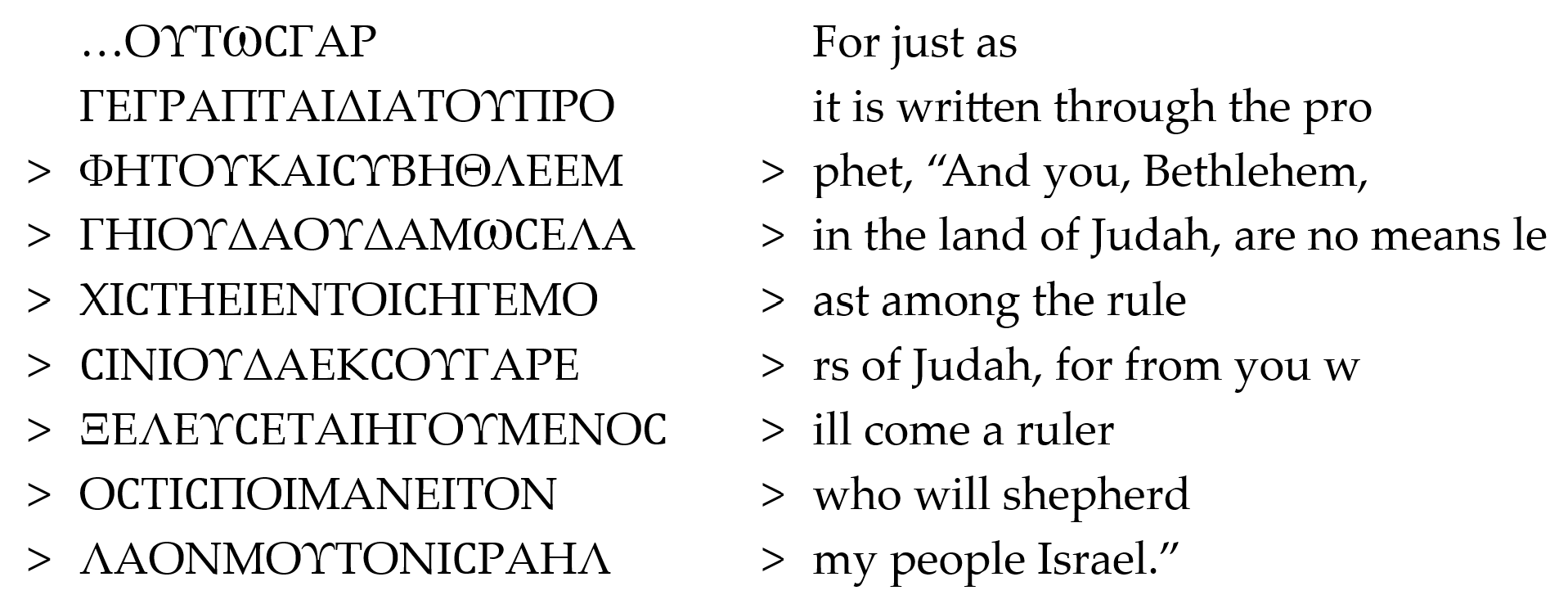
Among the selected manuscripts, the following use diplae at least sometimes to mark cited material: GA 01, 02, 03, 012, 1, 1424, and 1739. The visual appearance is fairly consistent, and often the diplae appear to be applied by the original scribe(s)—though in GA 03 the diplae were not always reinked (as was the rest of the biblical text) and, thus, occasionally appear faded. One interesting outlier is that GA 1739 sometimes uses an obelus (÷) in the margin instead of a diple.
In due course one even finds diplae in early manuscripts of patristic writings denoting not only OT but also NT citations;[15] thus, at first glance the diplae appear to signal “not only a distinct awareness of citation, but an awareness that what was marked was being set apart as scripture.”[16] For this reason, these markings are often denoted “diplae sacrae.” However, such marginal markings pre-date NT scribes and were used in secular works to mark cited material.
b. Indentation and colored text. Majuscule GA 06 of the Pauline Epistles does not use diplae but instead indents citations on dedicated lines and in most cases inks them in red. For instance, the citation of Gen 15:6 in Rom 4:3 appears as follows:
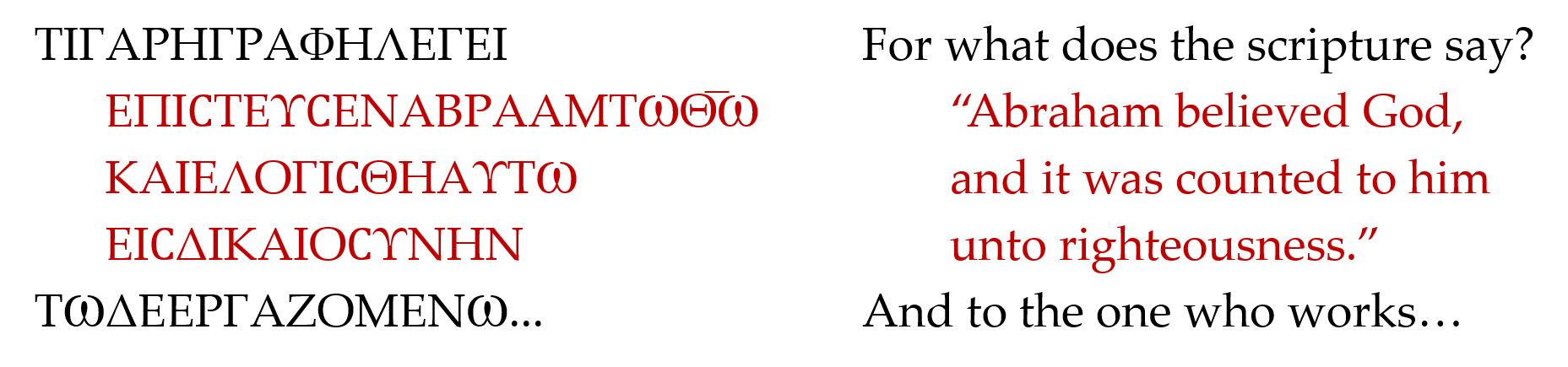
No other manuscript in the test set uses this feature for citations, though GA 01 uses red ink for psalm superscriptions and paragraph numbers in some places.
c. Marginal notes. Some scribes/editors indicate awareness of a citation by placing an attribution of the source in the left or right margin, roughly aligned with the lines containing the excerpt. For example, the quotation of Jer 9:22–23 in 1 Cor 1:31 is treated as follows in GA 1739:[17]

Among the selected manuscripts these notes are regularly found in GA 01, 1, 1424, and 1739. Interestingly, scribes/editors sometimes misattribute citations: e.g., the marginal note in GA 1424 for the citation of Deut 8:3 in Luke 4:4 reads ἐν τῷ ἐξόδῳ (“in Exodus”). But sometimes these notes show a measure of sophistication: e.g., GA 1424 correctly attributes the citation of Ps 78[77]:2 in Matt 13:35 with ψαλμοῦ but also adds ἠσαΐου (“Isaiah”), indicating familiarity with the well-known variant in the citation’s introductory formula even though the scribe himself did not include that reading.[18]
d. Line break, enlarged space, and/or punctuation. Particularly among the papyri but not limited to them, some scribes used fairly rudimentary ways of denoting citations via line breaks, enlarged spaces, and/or punctuation before and after the cited material to set it off from the surrounding text.[19] For instance, the citation of the sixth through ninth commandments in Rom 13:9 appears as follows in P46:
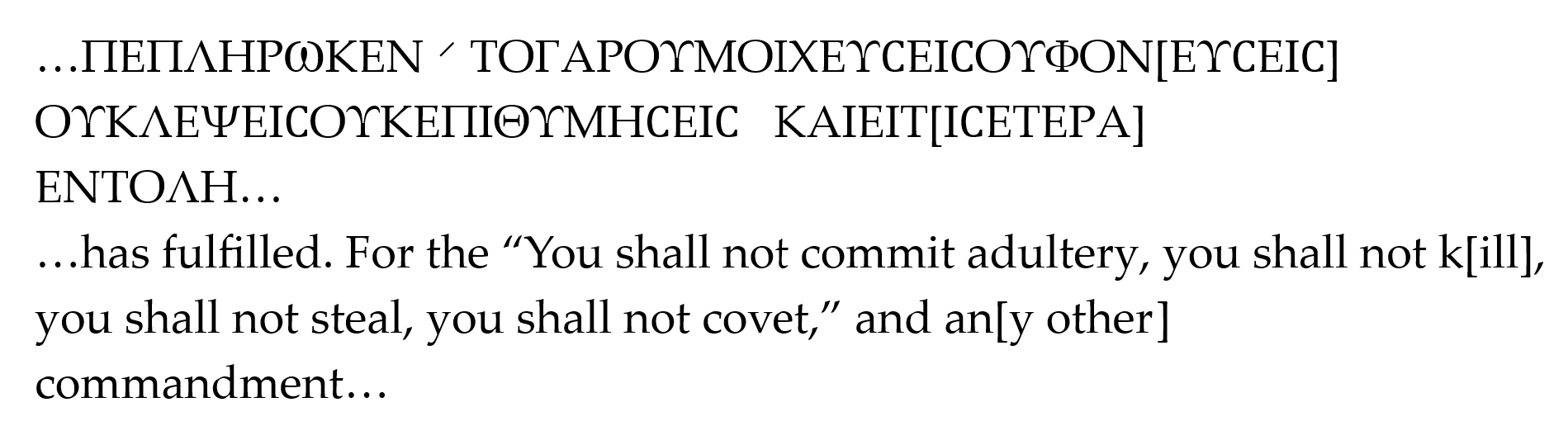
The cited text is introduced with a space and a raised solidus (after πεπλήρωκεν) and concluded with another large space (before καί). As another example, though GA 1 employs other more prominent features, the scribe sometimes settles for a simple line break and ekthesis (the extension of a word into the lefthand margin) to mark off cited text, as with the citation of Ps 68[67]:19 in Eph 4:8:
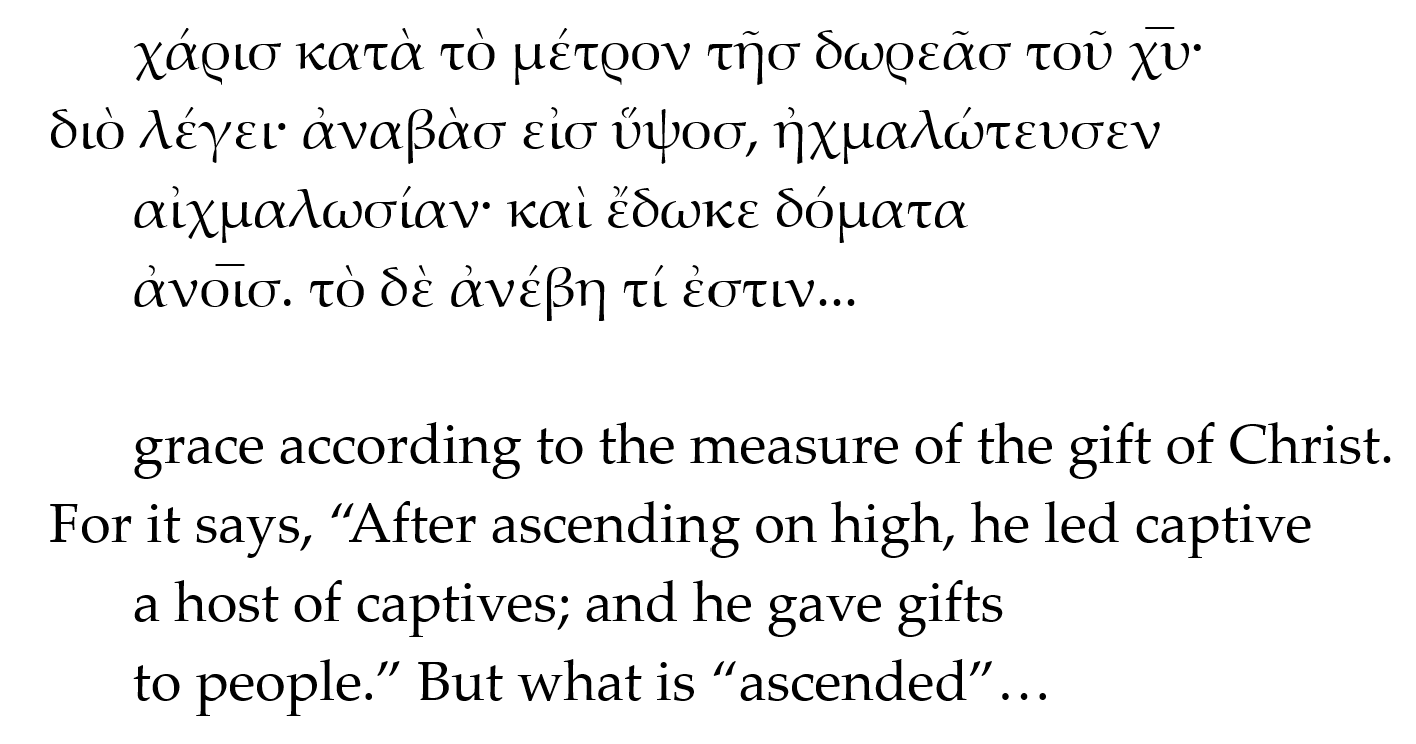
In the papyri such features are particularly important since structuring devices as a whole are only implemented in a rudimentary way. In majuscules and minuscules, they do not stand out as much because spacing, punctuation, and other features are used for a large variety of things (as in modern editions). Thus, in some cases one cannot infallibly determine if their use is meant to signal the scribe’s awareness of a citation or simply reflects the flow of the text.
Sometimes a manuscript combines features; e.g., GA 1424 includes diplae and a marginal attribution for the citation of the fifth commandment in Eph 6:2:[20]

These are the four main types of scribal habits for flagging citations within the selected pool of manuscripts. That said, it is important to note that in many cases a scribe/editor will do nothing at all to show awareness of a citation; the excerpted wording is indistinguishable from its surrounding text (denoted with – in §2 below). For instance, the citation of Hab 2:4 in Rom 1:17 is entirely unmarked in Codex 01:
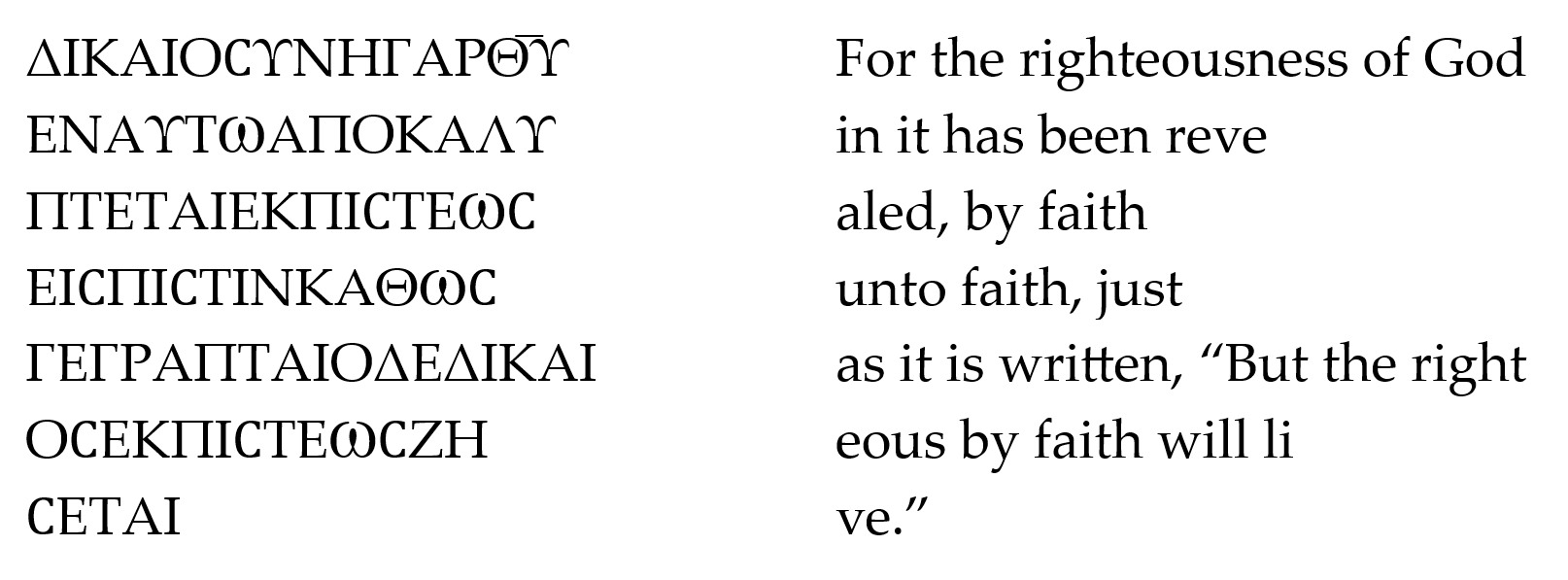
Having framed the approach, I will turn to exploring these scribal practices as they are used (or not used) for passages of interest.
II. Analysis of the Data
For each of the thirteen test passages, I will provide a brief overview of the debates about its cited source,[21] tabulate how the relevant manuscripts treat the control passages and passage in question (bold), and discuss the findings.[22]
1. Matthew 2:23. ὅπως πληρωθῇ τὸ ῥηθὲν διὰ τῶν προφητῶν ὅτι Ναζωραῖος κληθήσεται. “So that what was spoken through the prophets might be fulfilled: ‘He will be called a Nazarene.’”
The last fulfillment citation in the Matthean infancy narrative is also the most obscure. Though the introductory formula roughly matches the other four that draw verbatim from OT passages, there is no known concrete source for the phrase Ναζωραῖος κληθήσεται. The standard hypothesis is that the evangelist is providing some kind of loose summary of either the “Nazirite” concept (Num 6:2–21; Judg 13:5–7; Amos 2:11 MT) or the metaphor of the “shoot” (via Hebrew נצר, Isa 11:1).[23] The problem with the former is that Jesus does not keep the Nazirite stipulations; the problem with the latter is that the move from נזר to Ναζωραῖος is quite hard to explain; the problem with both is that the evangelist previously uses robust citation formulas to introduce verbatim excerpts, not vague summaries. Thus, we cannot rule out the possibility of an extra-biblical tradition, which is why I have included it as a test passage. The manuscript tabulation is as follows:
| Matt 1:22–23 | 2:5–6 | 2:15 | 2:17–18 | 2:23 | |
| Source | Isa 7:14 | Mic 5:1–3 | Hos 11:1 | Jer 31:15 | |
| GA 01 | Diplae
mg. ησαιου |
Diplae
mg. ησαιου |
Diplae
mg. εν αριθμοις |
Diplae | Diplae |
| GA 03 | Diplae | Diplae | Diplae | Diplae | Diplae |
| GA 1 | – | Diplae | – | Diplae | – |
| GA 1424 | – | – | – | – | – |
GA 01 applies diplae to all five formula citations including Matt 2:23, but the marginal notes for two of them are incorrect (“Isaiah” instead of “Micah” for Matt 2:5–6; “in Numbers” instead of “Hosea” for Matt 2:15); no guess is ventured for 2:23. GA 03 also features diplae for all five. The scribes for both, then, seem confident that Matt 2:23 is indeed a scriptural citation. Fast forward a few centuries and it is intriguing that both GA 1 and 1424 are rather reticent here, despite being fairly thorough elsewhere (as seen below). One wonders whether this reflects lower confidence that this citation is truly from the OT instead of some other source.
2. John 7:38. ὁ πιστεύων εἰς ἐμέ, καθὼς εἶπεν ἡ γραφή, ποταμοὶ ἐκ τῆς κοιλίας αὐτοῦ ῥεύσουσιν ὕδατος ζῶντος. “The one who believes in me, as the scripture said, ‘Out of his innermost parts will flow rivers of living water.’”
This statement raises thorny questions regarding translation—will the water flow from the believer or Jesus?—that need not detain us here.[24] Of greater interest is the passage’s source: what exactly is being cited, if anything? Jerome was, it appears, one of the earliest to recognize an issue here. In his Prologue to Chronicles he admits that it must be a scriptural citation, since Jesus says it is, but he cannot find it in “the Seventy,” the Hebrew, or the Apocrypha. Contemporary scholarship is rather indecisive in how to approach it. Some modern commentators think it is perhaps a loose conflation of Zech 14:7–8 and Ezek 47:2, but NA28 marks it unde? to suggest it is from an unknown extra-biblical source. The manuscript tabulation is as follows:[25]
| John 6:45 | 12:38 | 7:38 | |
| Source | Isa 54:3 | Isa 53:1 | |
| GA 01 | Line break Dot at end |
– | Paragraphos
Dot at end |
| GA 03 | Diplae | Diplae | Diplae |
| GA 1 | Ekthesis | Diplae | – |
| GA 1424 | Diplae | Diplae | – |
The Isaiah quotations in the control passages are almost universally marked, though it is surprising that GA 01 overlooks the prominent quotation in John 12. Notably, both majuscules do signal that their scribes view 7:38 as a real citation, but the minuscules do not. One wonders whether the later scribes were influenced by patristic hesitations stemming from the ambiguity of this citation.
3. Acts 17:28. ἐν αὐτῷ γὰρ ζῶμεν καὶ κινούμεθα καὶ ἐσμέν, ὡς καί τινες τῶν καθ᾿ ὑμᾶς ποιητῶν εἰρήκασιν· τοῦ γὰρ καὶ γένος ἐσμέν. “‘For in him we live and move and exist,’ as even some of your own poets have said—‘For we are indeed his offspring.’”
With the exception of Jude 14 (below), this passage as part of the Athens scene and Paul’s Areopagus discourse (Acts 17:16–34) is the most debated in the test set, and I can hardly do justice to all the complexities.[26] For the present, the central questions pertain to the source(s) of the excerpted wording—and whether there are two or one citation(s). I will begin with the second half of the verse because it is less disputed. The two contenders for the source of Acts 17:28b are Aratus’s Phaenomena (τοῦ γὰρ καὶ γένος εἰμέν, line 5) and Cleanthes’s Hymn to Zeus (ἐκ σοῦ γὰρ γένος ἐσμεν; some manuscripts, ἐκ σοῦ γὰρ γενόμεσθα).[27] The former is identified as early as Clement of Alexandria,[28] and in due course Euthalius ascribes 17:28b to, interestingly, “Aratus the astronomer and Homer the poet” (Ἀράτου ἀστρονόμου καὶ Ὀμήρου ποιητοῦ).[29] The latter’s different wording (ἐκ σοῦ) and text-critical uncertainty suggest that Cleanthes is not the direct source of Acts 17:28b; however, some argue that Aratus may have been drawing on Cleanthes’s hymn, such that Paul’s plural “poets” could encompass both.[30] The fact that the Jewish historian Aristobulus also quotes the introductory verses (including this one) from Aratus’s Phaenomena (Eusebius, Praep. ev. 13.12.3) shows that the poem was known among educated Jews—and it may raise the possibility that Aristobulus was an intermediate source for Acts.[31]
Turning to Acts 17:28a, I would note that there is some debate about whether “in him we live and move and exist” is intended to be a citation at all. But the plural τινες τῶν ποιητῶν seems to imply two, and there are various hypotheses about the alleged source for 17:28a, from Plato to Euripides to Callimachus to, most commonly, the Cretica of Epimenides.[32] The manuscript tabulation is as follows:
| Acts 2:16–21 | 28:25–27 | 17:28 | |
| Source | Joel 3:1–5 | Isa 6:9–10 | |
| P41 | (Not extant) | (Not extant) | Space and dot at end[33] |
| GA 01 | Ekthesis, diplae | – | – |
| GA 02 | Ekthesis, diplae | Diplae | – |
| GA 03 | Diplae | Diplae | Diplae (only for 17:28b) |
| GA 1 | – [34] | Diplae
mg. ησαιου |
– |
| GA 1424 | Diplae | mg. ησαιου | mg. ομηρου και αρατου |
| GA 1739 | Diplae
mg. ιωηλ |
Diplae | Obelus (÷)
mg. ομηρου και αρατου |
We have little to go on for the fragmentary P41, but if the patterns observed in other papyri (such as P46) hold here, then the space and dot after Acts 17:28 might signal the quotation. The scribes/editors of GA 01 and GA 02 do not mark 17:28 like they do other citations in Acts. GA 03 does apply diplae but only to 17:28b, apparently under the assumption that 17:28a is not a citation. Interestingly, its diplae were not reinked with the rest of the manuscript (but are still faintly visible), perhaps suggesting that the later editor did not want to highlight the pagan citation.
Among the minuscules, GA 1 ignores Acts 17:28, but this may mean little since the scribe appears inconsistent elsewhere. GA 1424 and 1739, however, are quite fascinating. Both original scribes (Sabas and Ephraim, respectively) place “Homer and Aratus” in the margin.[35] This combination likely shows familiarity with Euthalius, though “Aratus” could be traced back earlier to Clement. Either way, the treatment is akin to how the Joel and Isaiah quotations are marked elsewhere. Incidentally, though GA 1739 shows familiarity with Epimenides (Titus 1:12), no mention is made of him here.
4. First Corinthians 2:9. ἀλλὰ καθὼς γέγραπται· ἃ ὀφθαλμὸς οὐκ εἶδεν καὶ οὖς οὐκ ἤκουσεν καὶ ἐπὶ καρδίαν ἀνθρώπου οὐκ ἀνέβη, ἃ ἡτοίμασεν ὁ θεὸς τοῖς ἀγαπῶσιν αὐτόν. “But just as it is written, ‘What an eye has not seen, and an ear not heard, and has not ascended upon the heart of man—which God has prepared for those who love him.’”
Typically Isa 64:3 and 65:16 are offered as the source of Paul’s citation here, particularly in the Old Greek form (the relevant phrasing does not appear in the Hebrew tradition). However, there are numerous issues plaguing this hypothesis (lack of strong verbatim correspondence; differing conjugations for all verbs; lack of “ear” and “man” in Isaiah; substantially different points being made in Isaiah versus 1 Corinthians 2). In place of an OT solution are two other hypotheses. (1) The appearance of the same basic saying in Gos. Thom. 17 (and echoed in Acts Pet. 39, the Apocryphal Epistle of Titus, and the Turfan Fragment M 789) raises the possibility that Paul is quoting a free-floating logion of Jesus. (2) A handful of church fathers postulate that Paul is citing an Elijah apocryphon (Origen, Ps.-Ambrose, Euthalius)[36] and/or the Ascension of Isaiah (Jerome).[37] We lack any surviving evidence of this citation from an Elijah apocryphon, but the longer Latin version of Mart. Asc. Isa. 11:34 is close to Paul’s reading and appears to be independent of it.[38] A similar form of the saying is also attested in Ps.-Philo, LAB 26:13. The manuscript tabulation is as follows:
| Rom 3:9–18 | Rom 4:3 | 1 Cor 2:9 | |
| Source | Psalms, Isaiah | Gen 15:6 | |
| P46 | (Not extant) | (Not extant) | Space at beginning[39] |
| GA 01 | Diplae
mg. ψαλμω ιγ′ κ νβ′ |
Diplae
mg. γενεσεως |
– |
| GA 02 | Diplae | – | Line break, ekthesis |
| GA 03 | Diplae | Diplae | Diplae, paragraphos |
| GA 06 | Indent, red ink | Indent, red ink | Indent, red ink |
| GA 012 | Diplae | Diplae
mg. γενεσι |
Diplae
mg. εσαια αποκαλιψ ενοχ και ηλιας (sic) |
| GA 1 | Diplae | Diplae | Unclear |
| GA 1424 | mg. ψαλμου και ησαιου | mg. γεννεσι | mg. ηλια αποκρ[υφο]υ |
| GA 1739 | Diplae
mg. ψαλμ (plus various numbers), παροιμιου |
Diplae
mg. γενεσεως |
mg. αποκρυφου ηλιου |
Nearly all scribes in the test group mark 1 Cor 2:9 as a citation in some way that is more or less equivalent to how they treat the control group of OT citations.[40] The earlier manuscripts may have done so on suspicion that the cited wording is from canonical Isaiah. The marginal note of 012 is somewhat garbled, and it is difficult to determine whether “apocalypse” includes “Isaiah” (=Martyrdom) alongside “Enoch” and “Elijah” or if canonical Isaiah is intended. The evidence of GA 1 is inconclusive: the standard lectionary division ἀρχή is written in-line (rather than in the margin) between γέγραπται and ἃ ὀφθαλμός. GA 1424 and 1739 refer to an “Apocalypse of Elijah,” showing familiarity with the tradition going back to Origen or, more proximately, Euthalius.
5. First Corinthians 9:10. ἢ δι᾿ ἡμᾶς πάντως λέγει; δι᾿ ἡμᾶς γὰρ ἐγράφη ὅτι ὀφείλει ἐπ᾿ ἐλπίδι ὁ ἀροτριῶν ἀροτριᾶν καὶ ὁ ἀλοῶν ἐπ᾿ ἐλπίδι τοῦ μετέχειν. “Or does he not surely speak on our account? For it was written on our account that the one plowing ought in hope to plow and the one threshing in hope to partake.”
Following a citation of Deut 25:4 in 1 Cor 9:9, this somewhat elliptical statement is italicized and marked unde? by NA28 to imply that it is a citation that derives from an otherwise uncertain source.[41] However, some scholars question whether Paul is citing a second text in this passage. The aorist ἐγράφη is not a common citation formula; with the exception of the appeal to Gen 15:6 in Rom 4:22–23, it elsewhere serves as a more general description of scriptural application, not citation (Rom 15:4; 1 Cor 10:11). The same could be at play here: Paul may simply be unpacking the prior Deuteronomy citation.[42] The manuscript tabulation is as follows:[43]
| 1 Cor 9:9 | 9:10 | |
| Source | Deut 25:4 | |
| P46 | Space before and after | Space before and after |
| GA 01 | – | – |
| GA 02 | Diplae | Diplae |
| GA 03 | Diplae | – |
| GA 06 | – | – |
| GA 012 | Diplae
mg. δευτερονομιου |
– |
| GA 1 | – | – |
| GA 1424 | δευτερονομιου | – |
| GA 1739 | – | – |
Somewhat surprisingly, four of the nine manuscripts do not mark the rather explicit Deuteronomy citation. Even more interesting is the fact that only P46 and GA 02 treat 1 Cor 9:10 as a citation; one wonders for the latter whether the scribe/editor was simply careless in allowing the diplae to extend beyond the lines for 9:9. Otherwise, the evidence is unanimous that verse 10 was not deemed a citation by these scribes/editors—a phenomenon that might well be taken into consideration for how it is treated in future NA editions.
6. First Corinthians 15:33. μὴ πλανᾶσθε· φθείρουσιν ἤθη χρηστὰ ὁμιλίαι κακαί. “Do not be deceived: ‘Bad company corrupts good morals.’”
This verse immediately follows a verbatim use of Isa 22:13 (Old Greek) that is not marked with a citation formula (1 Cor 15:32). Verse 33 seems to violate my methodological guidelines regarding citations, since it lacks a typical citation formula. However, the idiom μὴ πλανᾶσθε is often used in diatribes as an introductory comment and, thus, seems to play that role here.[44] This factor combined with how the line is roughly hexameter causes most to consider it to be derived from a predecessor source.[45] The two leading contenders are Menander’s Thais (φθείρουσιν ἤθη χρήσθ᾽ ὁμιλίαι κακαί, line 218)—suggested by NA28—and Euripides (fragment 1024.4).[46] On the one hand, Origen claims Paul is citing a “comic playwright,” implying Menander but not naming him; Jerome and Euthalius explicitly attribute the line to Menander, and, interestingly, the latter also claims that 1 Cor 9:9 is not a quotation of Isaiah but a “Laconian proverb” (Λακωνικὴ παροιμία).[47] On the other hand, Clement of Alexandria calls it a “tragic iambic verse,” implying Euripides the tragedian, and Socrates the Scholastic specifically names Euripides.[48] It is possible that Menander made use of the plays of Euripides, which could explain the ambivalence. The manuscript tabulation is as follows:
| 1 Cor 15:32 | 15:33 | |
| Source | Isa 22:13 | |
| P46 | Space before, dot after | Line break, dot after |
| GA 01 | – | Line break |
| GA 02 | – | – |
| GA 03 | – | – |
| GA 012 | Diplae
mg. εσαια (sic) |
– |
| GA 1 | – | – |
| GA 1424 | mg. λακονικη και αρχαια ιστορια μεμνηται δε αυτης και ησαιας | |
| GA 1739 | Diplae
mg. λακωνικη ησαιας μεμνηται |
|
The broad range of scribal patterns reflects the underlying uncertainty about the source of these verses—and whether they are citations to begin with. P46, surprisingly, appears to signal awareness of both, but the majuscules and GA 1 are on the whole reticent. Both GA 1424 and 1739 reflect the influence of Euthalius in speaking of a “Laconic” phrase, though they also acknowledge some kind of “reminiscence” of Isaiah. The placement of their marginal notes (and diplae for 1739) seem intended to cover both verses, but neither acknowledge a different source for 15:33 (whether Menander or Euripides).
7. Ephesians 5:14. διὸ λέγει· ἔγειρε, ὁ καθεύδων, καὶ ἀνάστα ἐκ τῶν νεκρῶν, καὶ ἐπιφαύσει σοι ὁ Χριστός. “Therefore it says, ‘Awaken, O sleeper, and arise from the dead ones, and Christ will shine upon you.’”
“It says” is remarkably nonspecific but implies a citation here,[49] just as διὸ λέγει is used for the verbatim citation of Ps 68[67]:18 in Eph 4:8. The challenge is that there is no clear source of this wording in the OT or extant extra-biblical writings (hence NA28 unde?). Origen and Jerome argue that Paul wrote the passage himself,[50] while other fathers argue it was drawn from an early Christian hymn.[51] Hippolytus of Rome ascribes the wording to Isa 60:1 (with which it bears only a small resemblance).[52] Epiphanius attributes it to “Elijah”—perhaps the same apocryphon as mentioned for 1 Cor 2:9.[53] And Euthalius ascribes it to an “apocryphon of Jeremiah” (Ἰερεμίου ἀποκρύφου).[54] The manuscript tabulation is as follows:
| Eph 4:8 | 6:2 | 5:14 | |
| Source | Isa 22:13 | Deut 5:16 | |
| P46 | Line break before and after | – | Space before and after |
| GA 01 | – | – | Line break |
| GA 02 | Diplae | – | – |
| GA 03 | Diplae | Diplae | – |
| GA 06 | Indent, red ink | Indent, red ink | – |
| GA 012 | Diplae | – | Diplae
mg. i secreto enoch |
| GA 1 | Line break | Diplae | – |
| GA 1424 | mg. ψαλμου ξζ′ | Diplae
mg. δευτερονομιου |
mg. αποκρυφου ιερεμιου |
| GA 1739 | Diplae | Diplae
mg. δευτερονομιου |
Diplae
mg. ιερεμιου αποκρυφου |
Notably, the scribe of P46 treats Eph 5:14 as a citation but not 6:2. The major majuscules generally signal 4:8 as a quotation but not 5:14 despite identical introductory formulas; the line break for GA 01 is not terribly illuminating and could simply be syntactical. GA 012, so far as I am aware, is unique in offering “1 Apocryphal Enoch” (in Latin) as the source. GA 1424 and 1739 once again align with Euthalius.
8. First Timothy 5:18. λέγει γὰρ ἡ γραφή· βοῦν ἀλοῶντα οὐ φιμώσεις, καί· ἄξιος ὁ ἐργάτης τοῦ μισθοῦ αὐτοῦ. “For the scripture says, ‘Do not muzzle an ox while it is threshing,’ and, ‘The worker is worthy of his wages.’”
The first half of the verse is a verbatim citation of Deut 25:4. The connecting καί implies that the writer considers the second half of the verse to be said by “scripture” as well. But therein lies the issue: no clear OT passage contains this wording, and possible extra-biblical sources are rather remote (Jewish or otherwise).[55] Accordingly, NA28 marks it unde? to indicate it derives from some extra-biblical source that is otherwise unknown. There is, however, an nearly identical Jesus-saying in Luke 10:7 (ἄξιος γὰρ ὁ ἐργάτης τοῦ μισθοῦ αὐτοῦ); the parallel in Matt 10:10 uses “food” instead of “wages” and is reflected in Did 13:2 (ἐστιν ἄξιος καὶ αὐτὸς ὥσπερ ὁ ἐργάτης τῆς τροφῆς αὐτοῦ). Thus, a common hypothesis is that 1 Tim 5:18b is citing an early Jesus tradition, notably placing it on par with Deut 25:4 as γραφή. Euthalius even attributes 5:18b to the Matthean version (ἐκ τοῦ Ματθαῖον εὐαγγελίου).[56] The manuscript tabulation is as follows:[57]
| 1 Tim 5:18a | 5:18b | |
| Source | Deut 25:4 | |
| GA 01 | – | – |
| GA 02 | Diplae | Diplae |
| GA 06 | Indent, red ink | Indent, red ink |
| GA 012 | Diplae
mg. δευτερονομιου |
Diplae |
| GA 1 | – | – |
| GA 1424 | mg. δευτερονομιου | mg. ματθαιου ευαγγελιου |
| GA 1739 | Diplae
mg. δευτερονομιου |
Diplae |
Across the board, if a manuscript bears signs of awareness of the first citation, it does so for the second as well; otherwise both are ignored. Likely the scribes/editors thought the saying in 5:18b was close enough to something biblical that it merited being treated in the same way as Deut 25:4. Only the scribe of GA 1424 attempts to identify the source, pointing to Matt 10:10 but not Luke 10:7—similar to Euthalius.
9. Second Timothy 2:19. ὁ μέντοι στερεὸς θεμέλιος τοῦ θεοῦ ἕστηκεν, ἔχων τὴν σφραγῖδα ταύτην· ἔγνω κύριος τοὺς ὄντας αὐτοῦ, καί· ἀποστήτω ἀπὸ ἀδικίας πᾶς ὁ ὀνομάζων τὸ ὄνομα κυρίου. “Yet the firm foundation of God stands, bearing this seal: ‘The Lord knows those who are his,’ and, ‘Let all who call upon the name of the Lord depart from injustice.’”
Second Timothy contains no other unambiguous citations, so this reference to the “seal” of God stands out despite being an odd introductory formula. There is broad consensus that the first citation is an excerpt from Num 16:5.[58] The second citation—linked with καί, suggesting it is part of the “seal”—is more debated (e.g., NA28 italicizes both halves of the verse as citations, but UBS5 only bolds 2:19a). It is commonly suggested that Sir 17:26 and/or 35:3 are the likely source(s) for at least part of the wording (ἀπόστρεφε ἀπὸ ἀδικίας and ἀποστῆναι ἀπὸ ἀδικίας, respectively).[59] This hypothesis is strengthened by the fact that the author shows familiarity with extra-biblical traditions elsewhere (Jannes and Jambres, 2 Tim 3:8). The manuscript tabulation is as follows:
| 2 Tim 2:19 | |
| Source | |
| GA 01 | Line break |
| GA 02 | – |
| GA 06 | Line break |
| GA 012 | Diplae |
| GA 1 | – |
| GA 1424 | – |
| GA 1739 | εξοδου |
Some scribes appear hesitant to mark this “seal” as a citation of a prior source; the line breaks of GA 01 and 06 may signal awareness or could just be typical discourse structuring. GA 012 marks both halves of the verse with diplae. GA 1739 treats something as a citation, but it is not clear whether “Exodus” applies to the first half of the verse or the second half since they share the line in the manuscript with which the marginal note is aligned; there is no clear antecedent for either in Exodus.
10. Titus 1:12. εἶπέν τις ἐξ αὐτῶν ἴδιος αὐτῶν προφήτης· Κρῆτες ἀεὶ ψεῦσται, κακὰ θηρία, γαστέρες ἀργαί. “One of their own prophets said, ‘Cretans are always liars, evil beasts, lazy gluttons.’”
In this loose form of the “liar’s paradox”—a Cretan calling Cretans liars—the writer purports to cite a line from a pagan prophet that approximates dactylic hexameter. Pinning down a concrete source has proven surprisingly difficult.[60] The first part of the excerpt is found verbatim in Callimachus’s Hymn to Zeus (Κρῆτες ἀεὶ ψεῦσται, line 8).[61] But some have attempted to trace the full line back to Epimenides, the semi-mythical philosopher of ancient Crete famed for his oracular gifts but who left few concrete traces.[62] Epimenides might, in turn, be interacting with a theme from Hesiod’s Theogony; and other ancient sources attribute the Cretan phrase to Homer or Euripides.[63] It seems the notion that Cretans are liars had attained almost proverbial status. Among the church fathers, Clement of Alexandria, Jerome, and Socrates Scholasticus attribute it to Epimenides;[64] Epiphanius and Euthalius do likewise but also remark that Callimachus has the same line, though they do not give the title of his hymn.[65] The manuscript tabulation is as follows:
| Titus 1:12 | |
| Source | |
| GA 01 | Line break |
| GA 02 | – |
| GA 06 | – |
| GA 012 | mg. cretenses |
| GA 1 | – |
| GA 1424 | – |
| GA 1739 | Obelus (÷)
mg. (see below) |
On the whole this set of scribes/editors is rather cautious about signaling this citation; the line break in GA 01 may not mean much, and the Latin note “Cretans” in GA 012 is ambiguous. The only manuscript paying much attention to this citation is GA 1739. One scribal hand reads as follows in the left margin:
Ἐπιμενίδου Κρητὸς μάντεως χρησμός. κέχρηται δὲ καὶ Καλλιμάχος τῇ χρήσει ἐν τῷ ὑπ” αὐτοῦ ῥηθέντι εἰς τὸν Δία ὕμνῳ.
Of Epimenides the Cretan, seer—an oracle. And Callimachus also makes use of it in his hymn spoken about Zeus.
This note is similar to but not identical with Euthalius and, notably, approximates the hymn’s title. A later editor adds Καλλιμάχου Κυρηναίου ποιητοῦ (“of Callimachus of Cyrene, the poet”) below the original note, more closely matching Euthalius.
11. James 4:5. ἢ δοκεῖτε ὅτι κενῶς ἡ γραφὴ λέγει· πρὸς φθόνον ἐπιποθεῖ τὸ πνεῦμα ὃ κατῴκισεν ἐν ἡμῖν. “Or do you suppose that the scripture says in vain, ‘He yearns in envy over the spirit he settled within us.’”
There are numerous text-critical and exegetical issues surrounding this verse that cannot be covered here. The chief question for the present purposes is whether ἡ γραφὴ λέγει signals a citation. One possibility is that Jas 4:5 is simply an authorial aside that prepares for the explicit citation of Prov 3:34 in verse 6.[66] Another is that it is a paraphrastic conflation of multiple OT passages (including alternative text-forms like the targums or Theodotion).[67] A final option is that it is a citation of a Jewish pseudepigraphon that is otherwise lost—the chief candidate being Eldad and Modad.[68] Interestingly, the church fathers are virtually silent on this passage, presumably due to its exegetical difficulties and the uncertainty about its source. The manuscript tabulation is as follows:[69]
| Jas 2:8 | 2:23 | 4:6 | 4:5 | |
| Source | Lev 19:18 | Gen 15:6 | Prov 3:34 | |
| GA 01 | – | Line break, paragraphos | – | – |
| GA 02 | Line break | Diplae | Diplae | – |
| GA 03 | – | Diplae | Diplae | – |
| GA 1424 | mg. δευτερονομιου | – | – | – |
| GA 1739 | – | – | – | – |
The treatment of biblical citations in these manuscripts is surprisingly unpredictable, which makes the lack of clear signaling of 4:5—despite the citation formula—difficult to interpret. Only GA 02 attempts to mark all three passages; GA 1424 cuts against its normal mode of marking such citations and even lists an incorrect source for Jas 2:8.[70] GA 1739 has unusually large spaces before and after the citation, but that may mean little. None of these scribes appear convinced this verse is a citation (biblical or otherwise)—reflecting the overall patristic hesitation.
12. Second Peter 2:22b. συμβέβηκεν αὐτοῖς τὸ τῆς ἀληθοῦς παροιμίας· κύων ἐπιστρέψας ἐπὶ τὸ ἴδιον ἐξέραμα, καί· ὗς λουσαμένη εἰς κυλισμὸν βορβόρου. “The true proverb has happened to them: ‘The dog returns to its own vomit,’ and, ‘The pig, after washing itself, to wallowing in the mud.’”
In describing how false teachers have seemingly embraced Jesus but then turned back to their old ways, the author cites a “true proverb” that is, via καί, actually two. The first is a repackaging of the expanded Greek version of Prov 26:11. The source of the second is unclear. Some, including NA28, suggest it derives from a saying of Heraclitus—something like, “Pigs delight in mud more than water”—that is recorded in various forms by Athenaeus, Columella, and Clement of Alexandria.[71] But this proverb is not quite aligned with the sense of 2 Pet 2:22b, where a pig returns to the mud after first seeking clean water. A better option is a proverb of Ahiqar 8:17–18: “My son, you have been to me like a pig who went into the bathhouse with nobles to bathe, and when it bathed and departed the bathhouse, it saw mud and wallowed in it.”[72] The manuscript tabulation is as follows:
| 1 Pet 2:6–8 | 2 Pet 2:22a | 2:22b | |
| Source | Isa 8:14; 28:16; Ps 118[117]:22 | Prov 26:11 | |
| GA 01 | –[73] | – | – |
| GA 02 | Diplae | – | – |
| GA 03 | Diplae | – | – |
| GA 1 | mg. ησαιου | mg. παροιμιων | mg. παροιμιων |
| GA 1424 | mg. ησαιου, ψαλμου ριζ′ | mg. παροιμιων | mg. παροιμιων |
| GA 1739 | Diplae
mg. ησαιου |
– | – |
The majuscules and GA 1739 (typically so liberal with such annotations) do not mark either part of the “proverb” in 2:22. The marginal notes in GA 1 and 1424 seem intended to cover both citations and ascribe them to Proverbs, aligning again with Euthalius (who attributes both halves of the verse to παροιμιῶν).[74] Probably due to the attraction of Proverbs, no mention is made of Heraclitus or Ahiqar, and one wonders whether the evidence of the former is strong enough to warrant the NA28 note.
13. Jude 14–15. Προεφήτευσεν δὲ καὶ τούτοις ἕβδομος ἀπὸ Ἀδὰμ Ἑνὼχ λέγων· ἰδοὺ ἦλθεν κύριος ἐν ἁγίαις μυριάσιν αὐτοῦ ποιῆσαι κρίσιν κατὰ πάντων καὶ ἐλέγξαι πᾶσαν ψυχὴν περὶ πάντων τῶν ἔργων ἀσεβείας αὐτῶν ὧν ἠσέβησαν καὶ περὶ πάντων τῶν σκληρῶν ὧν ἐλάλησαν κατ᾿ αὐτοῦ ἁμαρτωλοὶ ἀσεβεῖς. “And Enoch, the seventh from Adam, prophesied also about these, saying, ‘Behold, the Lord came with his holy myriads to make judgment against all, and to reprove every soul for all their deeds of ungodliness which they have done in ungodliness, and for all the cruelties which ungodly sinners have spoken against him.’”
Several church fathers were quite aware of this citation and reflected particularly on whether this passage is implicitly sanctioning the veracity of the well-known pseudepigraphon.[75] Modern scholars (too many to list here) tend to focus on reconstructing the text-form used by the author from among the surviving Greek, Aramaic, Ethiopic, and Latin witnesses as well as tracing larger connections to 1 Enoch in Jude—though some also reflect on the potential canon implications. The manuscript tabulation is as follows:[76]
| Jude 14–15 | |
| Source | |
| GA 01 | – |
| GA 02 | – |
| GA 03 | Diplae |
| GA 1 | Diplae
mg. ενωχ |
| GA 1424 | – |
| GA 1739 | Diplae
mg. ενωχ αποκρυφου |
It is not altogether unexpected that GA 01 and 02 omit signaling the Enoch citation. The marginal comments in GA 1 (written vertically) and 1739 (matching Euthalius’s Ἐνὼχ ἀποκρύφου)[77] are not too surprising either; I would have expected the scribe of 1424 to make some note given prior precedent. Most intriguing is the use of diplae not only in these two minuscules but also GA 03, seemingly placing the 1 Enoch citation on the same plane as biblical citations elsewhere.
III. Summary of Findings
I will now tabulate the data and derive tentative conclusions or raise further questions. In the charts below, the following key is used to denote scribal treatment of the control and test passages:
> diplae
¶ spacing/new line/indentation/coloration
@ marginal note
– no marking
(blank) not attested in the manuscript
The percent totals omit instances where a passage is not extant in a manuscript (blanks). I will begin with the control passages:
| P41 | P46 | 01 | 02 | 03 | 06 | 012 | 1 | 1424 | 1739 | % marked | |
| Matt 1:22–23 | > @ | > | – | – | 50 | ||||||
| Matt 2:5–6 | > @ | > | > | – | 75 | ||||||
| Matt 2:15 | > @ | > | – | – | 50 | ||||||
| Matt 2:17–18 | > | > | > | – | 75 | ||||||
| John 6:45 | ¶ | > | ¶ | > | 100 | ||||||
| John 12:38 | – | > | > | > | 75 | ||||||
| Acts 2:16–21 | > ¶ | > ¶ | > | – | > | > @ | 83 | ||||
| Acts 28:25–27 | – | > | > | > @ | @ | > | 83 | ||||
| Rom 3:9–18 | > @ | > | > | ¶ | > | > | @ | > @ | 100 | ||
| Rom 4:3 | > @ | – | > | ¶ | > @ | > | @ | > @ | 88 | ||
| 1 Cor 9:9 | ¶ | – | > | > | – | > @ | – | @ | – | 56 | |
| 1 Cor 15:32 | ¶ | – | – | – | > @ | – | @ | > @ | 44 | ||
| Eph 4:8 | ¶ | – | > | > | ¶ | > | ¶ | @ | > | 89 | |
| Eph 6:2 | – | – | – | > | ¶ | – | > | > @ | > @ | 56 | |
| 1 Tim 5:18a | – | > | ¶ | > @ | – | @ | > @ | 71 | |||
| Jas 2:8 | – | ¶ | – | @ | – | 40 | |||||
| Jas 2:23 | ¶ | > | > | – | – | 60 | |||||
| Jas 4:6 | – | > | > | – | – | 33 | |||||
| 1 Pet 2:6–8 | – | > | > | @ | @ | > @ | 83 | ||||
| 2 Pet 2:22a | – | – | – | @ | @ | – | 33 | ||||
| % marked | n/a | 75 | 45 | 71 | 84 | 80 | 83 | 65 | 70 | 64 | 69 |
Given the sample size and the peculiarities of each manuscript, I want to be cautious about drawing too many systemic conclusions. Even supplying numbers in the above tables runs the risk of giving a stronger impression of quantitative certitude or statistical significance than the sample set permits. With that vital caveat in mind, a few initial observations may be offered as a way to spur further inquiry into these scribal phenomenon—but not necessarily as offering any kind of claims regarding representative patterns.
From the perspective of these particular manuscripts, the degree of inconsistency in denoting clear citations of biblical material is quite high. No scribe is perfectly consistent, of course, but one wonders why a given scribe/editor would readily identify one OT passage but not another. GA 03 is the most consistent among those with a large data set (more passages would need to be sampled within the Paulines for 06 and 012), but nevertheless certain obvious citations go unmarked. GA 01 is interesting because the marking of citations sharply dwindles outside the Gospels/Acts and certain Paulines, perhaps due to editorial fatigue. Among the minuscules the scribe of GA 1424 is most rigorous—but why are the pronounced citations in Matthew unmarked? It is also interesting to observe that, on the whole, the frequency of successful scribal identification of citations does not really increase over time from earlier manuscripts to later. Finally, one question running throughout the analysis is whether a scribe is copying these features (diplae, line breaks, marginal notes, etc.) from an exemplar. If so, a fruitful avenue of future research might be to expand the pool of passages and manuscripts to see whether the identification or non-identification of OT citations can assist in reconstructing genealogical relationships among manuscripts.[78]
Moreover, from the perspective of the selected passages, there do not appear to be any appreciable patterns whereby certain NT books are handled better or worse in terms of citation identification (except perhaps the Catholics). The variability seems to relate to individual verses instead, but it is still unclear what drives the variation. Are certain introductory formulas more obvious to scribes than others? Are certain biblical books more familiar than others and, thus, attract more attention?[79]
The table for the test (extra-biblical) passages is as follows:
| P41 | P46 | 01 | 02 | 03 | 06 | 012 | 1 | 1424 | 1739 | % marked | |
| Matt 2:23 | > | > | – | – | 50 | ||||||
| John 7:38 | ¶ | > | – | – | 50 | ||||||
| Acts 17:28 | ¶ | – | – | > | – | @ | > @ | 57 | |||
| 1 Cor 2:9 | ¶ | – | ¶ | > ¶ | ¶ | > @ | – | @ | @ | 78 | |
| 1 Cor 9:10 | ¶ | – | > | – | – | – | – | – | – | 22 | |
| 1 Cor 15:33 | ¶ | ¶ | – | – | – | – | @ | > @ | 50 | ||
| Eph 5:14 | ¶ | ¶ | – | – | – | > @ | – | @ | > @ | 56 | |
| 1 Tim 5:18b | – | > | ¶ | > | – | @ | > | 71 | |||
| 2 Tim 2:19 | ¶ | – | ¶ | > | – | – | @ | 57 | |||
| Titus 1:12 | ¶ | – | – | @ | – | – | > @ | 43 | |||
| Jas 4:5 | – | – | – | – | – | 0 | |||||
| 2 Pet 2:22b | – | – | – | @ | @ | – | 33 | ||||
| Jude 14–15 | – | – | > | > @ | – | > @ | 50 | ||||
| % marked | n/a | 100 | 42 | 27 | 50 | 50 | 71 | 17 | 46 | 73 | 49 |
With the same caveats regarding small sample size as mentioned above, I would observe that, with one exception (Jas 4:5, arguably the most obscure of the set), each purported extra-biblical passage is explicitly marked by at least two manuscripts in the sample set. The overall rate of explicit marking (≈49% for the whole) is less than what we see for control passages above (≈69%)—but a 50/50 rate is still notable. This finding raises interesting questions about scribal familiarity with and reception of the NT’s engagement with antecedent Jewish and non-Jewish sources. While most research on extra-biblical influences on the NT tends to be limited to the opinions of, say, Tertullian, Origen, and Jerome, the behavior of scribes should also be factored into future discussions.
Furthermore, some scribes/editors are far more cautious about marking extra-biblical citations than biblical ones, such as GA 02, 03, and 1—perhaps stemming from a greater sense of awareness that such passages are not scriptural despite their introductory formulas. Yet other scribes/editors are equally willing to mark both types, such as P46, GA 01, 1424, and 1739. It seems implausible that this finding reflects greater confusion that such excerpts are from the traditional canon,[80] nor would it be justifiable to conclude from this data that these scribes operated with a broader or more fluid canon.[81] Rather, what seems to be at play for such manuscripts is a dilution of the significance of these scribal features, such that they are not so much diplae “sacrae” but generalized quotation marks (as was normal for secular manuscripts when citing other authors). One is forced, in turn, to reckon with this same possibility for the entire set of witnesses, which yields what is arguably the most interesting finding of this study. Not only does every scribe/editor mark some extra-biblical citations in the exact same way they mark some biblical citations, they often mark extra-biblical citations while failing to do so for biblical ones. GA 03, for instance, is very rigorous in marking clear OT citations but misses a few—and, in turn, uses the same diplae not only for the fuzzier examples like Matt 2:23 or John 7:38 but also for well-known pagan (Acts 17:28) and Jewish (Jude 14–15) sources. This may mean the scribe treats such sources as authoritative in the same way as scripture. But it more likely implies that we need a more nuanced understanding of diplae and similar paratextual features.
In most cases the indication of a citation’s source in a marginal note suggests that a scribe/editor was aware of patristic discussions of such matters. As pointed out above, for some passages the annotations in GA 1, 1424, and 1739 approximate but are not always identical with the opinions of Euthalius, the alleged 4–7th century architect of the eponymous apparatus that contains short and long inventories of OT citations.[82] Given the wide proliferation of the Euthalian materials across minuscules, this finding would not be surprising—except for the fact that GA 1424 and 1739 do not contain the apparatus at all, and GA 1 contains a few portions but not the citation/testimonia lists.[83] Their notes are telltale signs, then, that their scribes/editors had access to some form of the Euthalian materials, even if they do not implement them directly in the manuscript (or even omit Euthalius’s opinion for some citations). It would be worthwhile collating the marginal annotations about biblical citations against the Euthalian inventories to trace the upstream influences on Euthalius and assess his influence on scribes/editors of non-Euthalian manuscripts.[84]
Above I pointed out how the treatment of certain test passages by NA28 or UBS5 does not square well with the patristic and/or manuscript evidence (and the two editions are often inconsistent with each other). The evidence presented here could help refine the way these editions use indentation, italics/bold, and marginal comments to flag these verses. For instance, patristic opinions about a citation’s source could be added to the margin at 1 Cor 2:9, Eph 5:14, and 1 Tim 5:18b; the indentation and italics for 1 Cor 9:10 in NA28 should probably be removed; and the fairly obvious citations at Acts 17:28, 1 Cor 15:33 and Titus 1:12 could be set in italics/bold.
Though this initial study of scribal habits for denoting cited extra-biblical materials in the NT has only scratched the surface, it has yielded interesting insights and avenues for further work. The framework used for studying this smaller data set could be scaled up for the considerably larger set of biblical citations—and rolled out across more manuscripts—to push things even further.
[1] A modified version of this essay was delivered as a professorial lecture at Reformed Theological Seminary on April 9, 2025.
[2] See extensive studies and bibliography in G.K. Beale, D.A. Carson, Benjamin Gladd, and Andrew Naselli, Dictionary of the New Testament Use of the Old Testament (Grand Rapids: Baker Academic, 2023).
[3] E.g., Larry Hurtado, The Earliest Christian Artifacts: Manuscripts and Christian Origins (Grand Rapids: Eerdmans, 2006); Thomas Kraus and Tobias Niklas, eds., New Testament Manuscripts: Their Texts and Their World, TENTS 2 (Leiden: Brill, 2006); Charles E. Hill, The First Chapters: Dividing the Text of Scripture in Codex Vaticanus and Its Predecessors (Oxford: Oxford University Press, 2022).
[4] Charles E. Hill devotes a few sentences to this “little-noted feature of some early manuscripts” in “A Four-Gospel Canon in the Second Century? Artifact and Arti-fiction,” EC 4 (2013): 310–334. Edgar B. Ebojo does preliminary work on how the scribe of P46 handles scriptural quotations in Hebrews in “A Scribe and His Manuscript: An Investigation into the Scribal Habits of Papyrus 46 (P. Chester Beatty ii – P. Mich. Inv. 6238),” Ph.D. dissertation, University of Birmingham (2014). Andrew Smith tabulates the sixteen such citation markings in the Gospels of GA 02/A but does not otherwise discuss them at length in A Study of the Gospels in Codex Alexandrinus: Codicology, Palaeography, and Scribal Hands, NTTSD 48 (Leiden: Brill, 2014), 207–209. Peter Williams mentions an example from GA 03/B in “Problems with the Explicit Marking of Quotations in Translations and Scholarly Editions of the New Testament,” in Studies on the Intersection of Text, Paratext, and Reception: A Festschrift in Honor of Charles E. Hill, edited by Gregory R. Lanier and J. Nicholas Reid, TENTS 15 (Leiden: Brill, 2021): 259–278. The diplae in Vaticanus and Sinaiticus are helpfully covered in Ulrich Schmid, “Diplés im Codex Vaticanus” and “Diplés und Quellenangaben im Codex Sinaiticus,” in Von der Septuaginta zum Neuen Testament: Textgeschichtliche Erörterungen, edited by Martin Karrer, Siegfried Kreuzer, and Marcus Sigismund, ANTF 43 (Berlin: de Gruyter, 2010): 83–98 and 99–113; the marking of scriptural (not extra-biblical) quotations in a variety of manuscripts is discussed in Sean A. Adams and Seth M. Ehorn, “Composite Citations in New Testament Greek Manuscripts, in Studies on the Paratextual Features of Early New Testament Manuscript, edited by Stanley E. Porter, David I. Yoon, and Chris Stevens, TENTS 16 (Leiden: Brill, 2023): 227–66. The scribal feature is not covered detail in Liv Ingeborg Lied and Marilena Maniaci, eds., Bible as Notepad: Tracing Annotations and Annotation Practices in Late Antique and Medieval Biblical Manuscripts (Berlin: de Gruyter, 2018).
[5] David R. Herbison, “Textual Editing and Documentary Continuity: Marking of Old Testament Quotations in Editions and Manuscripts of the Greek New Testament,” in (Un)Documented: Was bleibt vom Dokument in der Edition?, edited by Mira Berghöfer et al. (Berlin: de Gruyter, 2020): 139–156.
[6] Distinguishing the work of an original scribe from later editors/correctors is vital to many tasks in textual criticism but opens the door to numerous difficulties that go well beyond what can be covered here, especially as the issues vary on a case-by-case basis for each manuscript. This study is not, however, diachronic in nature; that is to say, I am not at this stage making any assertions that require firmly distinguishing the layers of editorial work on a manuscript. As such, I will focus purely on the existence of paratextual features and not stratify them in terms of original scribes versus later scribal editors or end users. A more in-depth project could attempt to do so.
[7] E.g., the potential use of Wisdom 13–15 in Rom 1:18–2:5 (Jonathan Linebaugh, God, Grace, and Righteousness in Wisdom of Solomon and Paul’s Letter to the Romans: Texts in Conversation, NovTSup 152 [Leiden: Brill, 2013], 96–99); the allusion to the Martyrdom and Ascension of Isaiah in 1 Cor 2:9 and Heb 11:37 (Peter Stuhlmacher, “The Significance of the Old Testament Apocrypha and Pseudepigrapha for the Understanding of Jesus and Christology,” in The Apocrypha in Ecumenical Perspective, edited by S. Meurer, translated by Paul Ellingworth, UBSMS 6 [New York: United Bible Societies, 1991], 1–15); and the reference to the Ascension or Assumption of Moses in Jude 9 (Richard Bauckham, Jude and the Relatives of Jesus in the Early Church [Edinburgh: T&T Clark, 1990], 235–280). For extensive study of such extra-biblical material, see Gregory R. Lanier, Apocryphal Prophets and Athenian Poets: Noncanonical Influences on the New Testament (Nashville: B&H Academic, 2024).
[8] I will discuss below the hypothesis that 2 Pet 2:22 is citing Heraclitus.
[9] The * denotes those marked unde? (“where from?”) in NA28.
[10] See Vadim Wittkowsky, “‘Pagane’ Zitate im Neuen Testament,” NovT 51 (2009): 107–126.
[11] This is true not only for papyri but even for a well-known majuscule like GA 04 (Ephraemi Rescriptus), which lacks leaves for several of the test passages; moreover, the interference of the overtext presents enormous difficulties in discerning scribal treatment of citations with any degree of confidence.
[12] P41 can be viewed at http://data.onb.ac.at/dtl/3787953. P46 (P. Chester Beatty II/ P. Mich. Inv. 6238) can be viewed at https://manuscripts.csntm.org/manuscript/Group/GA_P46_Mich.
[13] GA 01 (BL Add MS 43725) can be viewed at https://codexsinaiticus.com/en/manuscript.aspx; GA 02 (Royal MS 1 D VII) at https://www.bl.uk/manuscripts/Viewer.aspx?ref=royal_ms_1_d_viii_fs001r; GA 03 (Vat.gr.1209) at https://digi.vatlib.it/view/MSS_Vat.gr.1209; GA 06 (a Greek-Latin diglot; BnF Grec 107) at https://gallica.bnf.fr/ark:/12148/btv1b84683111; GA 012 (Msc. Dresd. A 145b) at https://manuscripts.csntm.org/manuscript/View/GA_012, though the facsimile is useful (Alexander Reichardt, Der Codex Boernerianus: der Briefe der Apostels Paulus [Leipzig: Karl W. Hiersemann, 1909]).
[14] GA 1 (Codex Basilensis AN IV 2) is an important member of Family 1 and can be viewed at https://manuscripts.csntm.org/manuscript/View/GA_1. GA 1424 is the earliest minuscule containing the entire NT and can be viewed at https://manuscripts.csntm.org/Manuscript/Group/GA_1424. GA 1739 (Lavra B.64) can be viewed at https://www.loc.gov/resource/amedmonastery.00271051190-ma/?st=gallery or https://ntvmr.uni-muenster.de/manuscript-workspace?docID=31739 (see Jacob Peterson, “GA 1739: A Monk, His Manuscript and the Text of Paul’s Letters,” Ph.D. dissertation, University of Edinburgh [2020]). Given that minuscules 33 and 69 were off the table, I settled on these three as helpful starting points (but by no means representatives of the whole); follow-on work could, of course, add more minuscules to the mix.
[15] P.Oxy. 405, where Irenaeus cites Matt 3:16; P.Mich. 764, marking a citation of 1 Cor 3:13.
[16] Charles E. Hill, “‘In These Very Words’: Methods and Standards of Literary Borrowing in the Second Century,” in The Early Text of the New Testament, edited by Charles E. Hill and Michael J. Kruger (Oxford: Oxford University Press, 2012), 261–281 (280).
[17] Medial sigma (σ) reflects the orthography of the scribal hand (also for GA 1 below). The scribe also mentions βασιλείων αʹ, implying that the lengthy addition in Old Greek 1 Kgdms 2:10 is also in view.
[18] Namely, several manuscripts insert διὰ τοῦ προφήτου ἠσαΐου.
[19] See a brief description for P46 in Edgar B. Ebojo, “When Nonsense Makes Sense: Scribal Habits in the Space-Intervals, Sense-Pauses, and Other Visual Features in P46,” TBT 64 (2013): 128–150.
[20] Image of GA 1424 provided by the Center for the Study of New Testament Manuscripts and used with permission from the Monastery of Panagia Eikosifoinissa and the Holy Metropolis of Drama, Greece.
[21] All translations are my own. To avoid bloating the footnotes, I will keep references to secondary literature somewhat limited as my goal here is not to weigh in on any particular one of these passages per se.
[22] If a manuscript lacks the passage in question, it will not be listed in the table.
[23] Krister Stendahl, The School of St. Matthew and Its Use of the Old Testament, 2nd ed., ASNU 20 (Lund: Gleerup, 1968), 103–140, 198–199.
[24] Richard Hays, Echoes of Scripture in the Gospels (Waco, TX: Baylor University Press, 2016), 314–316.
[25] GA 02 is missing the leaf for John 7:38 and is, thus, excluded.
[26] For a helpful overview and bibliography, see Clare K. Rothschild, Paul in Athens: The Popular Religious Context of Acts 17, WUNT 341 (Tübingen: Mohr Siebeck, 2014).
[27] Texts from Douglas Kidd, Aratus: Phaenomena (Cambridge: Cambridge University Press, 1997); Johan C. Thom, Cleanthes’ Hymn to Zeus: Text, Translation, and Commentary, STAC 33 (Tübingen: Mohr Siebeck, 2005).
[28] Strom. 1.19.41–42 (PG 8: 808); see also Strom. 5.14.20–24. Clement’s use of plural “poetical examples” (ποιητικοῖς παραδείγμασιν) implies he thinks both lines of Acts 17:28 derive from Aratus.
[29] PG 85: 644. He may be influenced by Posidonius, who wrote a comparison of Aratus and Homer.
[30] C. Kavin Rowe, World Upside Down: Reading Acts in a Graeco-Roman Age (Oxford: Oxford University Press, 2009), 37–38.
[31] Mark J. Edwards, “Quoting Aratus: Acts 17:28,” ZNW 83 (1992): 266–269.
[32] Cretica is often reconstructed via a Syriac fragment that includes Titus 1:12 as well, which also may derive from Epimenides (see below); see J. Rendel Harris, “A Further Note on the Cretans,” Expositor 3 (1907): 332–337.
[33] The beginning of Acts 17:28 is not extant in the fragment, unfortunately.
[34] However, diplae appear at the next citation in Acts 2:25–28.
[35] It is unclear whether the obelus is original or secondary in 1739. The same note is written vertically in the margin of the ninth century GA 014 (Codex Ha).
[36] Origen Comm. ser. Matt. 117 (PG 13: 1769); Ambrosiaster, Comm. 1 Cor. at 2:9 (PL 17: 194–195); Euthalius reads Ἠλία ἀποκρύφου (PG 85: 721).
[37] Jerome repudiates the option of the Apocalypse of Elijah in Ep. 57.9 but admits the quotation is found in both Ascensio Isaie and apocalypsis Eliae in Comm. Isa. 17 (PL 24: 646).
[38] See August Dillmann, Ascensio Isaiae: Aethiopice et Latine (Leipzig: Brockhaus, 1877), 82.
[39] Note that spaces also delimit the quotation of Gen 2:24 in 1 Cor 6:16.
[40] The evidence for P46 is the least decisive, and the diplae in GA 03 again are faint due to lack of reinking.
[41] UBS5 does not apply bold type to it.
[42] Yet Martin Hengel still suggests that “an unknown pseudepigrapha is conceivable” (The Septuagint as Christian Scripture: Its Prehistory and the Problem of Its Canon, translated by Mark E. Bidde [Edinburgh: T&T Clark, 2002], 109).
[43] See other Pauline control passages above.
[44] See its use in Epictetus, Diatr. 4.6.23; 2 Macc 7:18; Jas 1:16–17.
[45] NA28 and UBS5 indent the text but do not set it in italics/bold. Chrysostom, however, believed it to be Paul’s own wording (Hom. 1 Cor. 40).
[46] Texts from W.G. Arnott, Menander: Aspis, Georgos, Dis Exapaton, Dyskolos, Encheiridion, Epitrepontes, LCL 132 (Cambridge, MA: Harvard University Press, 1979); Christopher Collard and Martin Cropp, Euripides, Volume VIII: Oedipus-Chrysippus, Other Fragments, LCL 506 (Cambridge, MA: Harvard University Press, 2009). See patristic discussion in Vadim Wittkowsky, Warum zitieren frühchristliche Autoren pagane Texte? Zur Entstehung und Ausformung einer literarischen Tradition, BZNW 218 (Berlin: de Gruyter, 2015), 56–77.
[47] Origen, Hom. Luc. 31.3; Jerome, Ep. 70.2; for Euthalius see PG 85: 721 and Yury Arzhanov, “Menander in Syriac: From Euthalian Apparatus to Scholia on Gregory of Nazianzus,” Studia Graeco-Arabica 7 (2017): 57–74.
[48] Clement of Alexandria, Strom. 1.14.39–40; Socrates Scholasticus, Eccl. hist. 3.16.26.
[49] UBS5/NA28 indent the verse but do not use bold/italics.
[50] See Origen in J.A. Cramer, Catenae Graecorum Patrum in Novum Testamentum: Catena in Sancti Pauli, Epistolas ad Galatas, Ephesios, Philippenses, Colossenses, Thessalonicenses (Oxford: Oxford University Press, 1842), 197; Jerome, Comm. Eph. at 5:14.
[51] Theodoret, Comm. Eph. at 5:14; Severian of Gabala (see PG 41: 807).
[52] Hippolytus, Comm. Dan. 4.56.4.
[53] Epiphanius, Pan. 42.12.3 (scholion 2 and 37).
[54] PG 85: 721.
[55] E.g., Euripides, Rhes. 191; see discussion in Michael J. Kruger, “First Timothy 5:18 and Early Canon Consciousness: Reconsidering a Problematic Text,” in The Language and Literature of the New Testament: Essays in Honor of Stanley E. Porter’s 60th Birthday, edited by Lois K. Fuller Dow, Craig A. Evans, and Andrew W. Pitts, BIS 150 (Leiden: Brill, 2017), 680–700.
[56] PG 85: 744.
[57] There are no other citations in the Pastorals; see the prior examples from the Pauline corpus for controls (here and for 2 Tim 2:19 and Titus 1:12, below).
[58] E.g., Euthalius marks it Ἀριθμῶν (PG 85: 744).
[59] E.g., NA28 margin; Lee McDonald writes, “Second Timothy appears to cite Sir 17:26 along with Num 16:5” (The Formation of the Christian Biblical Canon [Peabody, MA: Hendrickson, 1995], 101); likewise Stuhlmacher, “Significance,” 2.
[60] NA28 does not even try. UBS5 does not set the line in bold but attributes it to “Epimenides, de Oraculis,” as did NA27.
[61] Text from S.A. Stephens, Callimachus, The Hymns (Oxford: Oxford University Press, 2015). Origen is aware of this line but does not connect it to Titus 1:12 (Cels. 3.43).
[62] The full line has been reconstructed from the Syriac manuscript mentioned above (Acts 17:28).
[63] See Erkki Koskenniemi, “The Famous Liar and the Apostolic Truth,” Filología Neotestamentaria 24 (2011): 59–69; Elwire Kaczyńska, “Epimenides” Tale of the Birth of Zeus,” Graeco-Latina Brunensia 21 (2016): 1–12.
[64] Clement of Alexandria, Strom. 1.14.37; Jerome, Comm. Tit. at 1:12; Socrates Scholasticus, Eccl. hist. 3.16.24.
[65] Epiphanius, Pan. 42.12.3 (scholion 13 and 21). The long form of the Euthalian note reads, “Of Epimenides the Cretan, seer—an oracle, and the same of Callimachus of Cyrene, the poet” (Ἐπιμενίδου Κρητὸς καὶ μάντεως χρησμός, καὶ Καλλιμάχου Κυρηναίου ποιητοῦ ἡ αὐτή); see John G. Cook, “Titus 1:12: Epimenides, Ancient Christian Scholars, Zeus’s Death, and the Cretan Paradox,” ZAC 25 (2021): 367–394.
[66] Sophie Laws, “Does Scripture Speak in Vain? A Reconsideration of James iv.5,” NTS 20 (1974): 210–215.
[67] Petr Mareček, “A Crux Interpretatum in Jas 4:5,” Edinost in Dialog (2020): 95–118.
[68] Dale Allison, “Eldad and Modad,” JSP 21 (2011): 99–131.
[69] GA 1 includes a marginal note γενεσεως for Jas 2:23 but the leaf for Jas 4:5–6 is missing, so it is excluded.
[70] Perhaps Sabas conflated Lev 19:18 with Deut 6:5 via Matt 22:37–39; Euthalius reads “Leviticus.”
[71] See G.S. Kirk, Heraclitus, the Cosmic Fragments: A Critical Study with Introduction, Text and Translation (Cambridge: Cambridge University Press, 1954), 76–80. A similar saying is found in Sextus Empiricus, Pyr. 1.14.56.
[72] Translated from the Syriac in J. Rendel Harris, F.C. Conybeare, and A.S. Lewis, The Story of Ahikar from the Aramaic, Syriac, Arabic, Armenian, Ethiopic, Old Turkish, Greek and Slavonic Versions, 2nd ed. (Cambridge: Cambridge University Press, 1913). Ahiqar was well-known among some Second Temple Jews (e.g., Tobit 14). A strong case for 2 Peter’s use of this proverb is found in Richard Bauckham, 2 Peter, Jude, WBC 50 (Waco, TX: Word Books, 1983), 280; other recent commentators follow suit.
[73] Though diplae appear for the unmarked quotation of Isa 53:9 in 1 Pet 2:22.
[74] PG 85: 673.
[75] E.g., Clement of Alexandria, Adumbr. Jude 14; Tertullian, Cult. fem. 1.3.1–3; Jerome, Vir. ill. 4
[76] There are no other citations in Jude, so see the other Catholics for controls.
[77] PG 85: 676.
[78] An initial step in such an analysis would be to trace incorrect attributions (such as “Deuteronomy” instead of “Leviticus” at Jas 2:8 in GA 1424), treating them in effect like singular readings in text-critical work.
[79] With these data I did a brief cut of the numbers by OT book to see whether, say, Genesis or Isaiah were more successfully marked by scribes than others. The frequency distribution was not statistically significant, however (some Isaiah citations were identified 100% of the time, others 50%); the two Proverbs citations were at the bottom of the list, but with a small sample I would hesitate to draw conclusions here.
[80] Especially for the latter two that often do clearly identify the non-OT sources.
[81] One could perhaps make a case for this with regard to 1 Enoch in Jude 14–15 but hardly the others.
[82] For more on the Euthalian citation lists, see Garrick Allen, “Early Textual Scholarship on Acts: Observations from the Euthalian Quotation Lists,” Religions 13 (2022): 435–449.
[83] Per the manuscript inventory in Louis Charles Willard, A Critical Study of the Euthalian Apparatus, ANTF 41 (Berlin: de Gruyter, 2009), 160–169.
[84] E.g., the marginal notes at Rom 3:9–18 and 4:3 in GA 01 are identical to those of Euthalius.
