Theology in Context: A Reformed Catholic Vision for Anglicanism
Justin S. Holcomb
Bishop of the Episcopal Diocese of Central Florida
In a world increasingly marked by fragmentation and polarization, the church serves as a sign and witness of the unity given in Christ—grounded in the gospel and rooted in the historic faith. Reformed Catholicity offers the Anglican Communion a theological approach for maintaining this unity—retrieving its catholic heritage while remaining faithful to the biblical, Christ-centered, and evangelical convictions at the heart of its historic witness. Having seen firsthand how this “theological sensibility”[1] enriches Anglican theology, worship, and mission, I am convinced that Reformed Catholicity is not only a retrieval of the past but also a fruitful and promising path for the church’s future.
Reformed Catholicity provides a theological approach that upholds sola Scriptura while emphasizing the necessity of retrieving the catholic tradition for the renewal of the church. This model is particularly well-suited to Anglicanism, which has historically embodied this vision—upholding the sovereign authority of Holy Scripture as the rule for faith and life, proclaiming the gracious promises of God, and preserving a deep commitment to the church’s historic confessions, creeds, and worship.
The Anglican Communion, however, faces significant theological and ecclesial challenges: growing doctrinal fragmentation, contested views on biblical authority, and the challenge of maintaining unity across a global church. How can Anglicanism recover its theological coherence without sacrificing its catholicity?
Anglicanism stands at a moment of renewal, where reclaiming its confessional heritage is not a nostalgic exercise but a means of strengthening the church’s mission, evangelism, worship, discipleship, and theological education.
Reformed Catholicity and the Anglican Commitment to Retrieval
A central insight of Reformed Catholicity is that theological retrieval is not mere nostalgia or antiquarianism but a constructive theological approach—a means of drawing on the past to deepen the church’s theological clarity in the present. This vision is not foreign to Anglicanism; rather, it aligns closely with its foundational commitment to theological and liturgical retrieval.
Anglicanism has practiced a “ruled reading”[2] of Scripture, guided by the creeds, the Book of Common Prayer, and the Thirty-Nine Articles. These historic resources do not function as rivals to Scripture but as faithful expressions of its teaching. Article VIII explicitly affirms the Nicene, Athanasian, and Apostles’ Creeds as binding because they can be proved “by most certain warrants of Holy Scripture.” Anglican theology, therefore, has never sought to dismiss tradition but to subject it to biblical authority while valuing its role in shaping doctrine and worship.
Reformed Catholicity offers Anglicans a renewed theological framework. This approach engages patristic, medieval, and Reformation theology not as static traditionalism but as a means of ensuring doctrinal fidelity, biblical clarity, and faithful spiritual formation. As Allen and Swain emphasize, sola Scriptura is not a rejection of tradition but a call to interpret Scripture within the wisdom of the historic church.
When Anglican theology veers toward being uncritically progressive or historically untethered or defined by cultural assumptions, Reformed Catholicity provides a path forward—one that recognizes Scripture’s ultimate authority while embracing the wisdom of the church’s historic confessions and theological traditions.
Reformed Catholicity as a Foundation for Unity in Diversity
A primary challenge for the global Anglican Communion is maintaining theological and ecclesial unity without suppressing the diversity that arises from its broad cultural, linguistic, ethnic, and geographical reach.
Reformed Catholicity encourages Anglicanism to root its catholicity in biblical fidelity and apostolic witness—not institutional uniformity. Historically, Anglicanism has modeled this approach: its unity is not based on strict doctrinal conformity at every point but on a common confessional core found in the Creeds, the Book of Common Prayer, and the Articles.
This vision of catholicity, rooted in retrieval, serves as a corrective to the theological fragmentation within Anglicanism today. When Anglican dioceses or provinces drift from their historic theological commitments—whether toward doctrinal minimalism, theological revisionism, or ecclesial isolationism—Reformed Catholicity offers a steady path forward. It provides an approach to Anglican unity that is not rooted in institutional structures alone but in the church’s shared theological and biblical heritage.
With 85 million members across 42 autonomous provinces, Anglicanism is marked by vast theological, cultural, and liturgical diversity. Some provinces lean toward low-church evangelicalism, others toward Anglo-Catholic sacramentalism, some charismatic expressions of worship, and still a few others toward progressive theological revisionism. The retrieval model of Reformed Catholicity—anchored in confessional fidelity while allowing for appropriate diversity in expression—offers Anglicanism a path toward recovering a theological identity rooted in historic Christianity rather than being fragmented by doctrinal revisionism.
Theology in Context: A Global Reformed Catholic Vision
Rather than simply applying theology to cultural contexts, Reformed Catholicity calls the church to exegete Scripture and its doctrines together from distinct cultural backgrounds. It resists the temptation of “contextual theology” that merely adapts doctrine to cultural pressures and instead insists on “theology in context”[3]—an approach that acknowledges cultural distinctives while maintaining biblical and theological fidelity.
The Anglican Communion, with its presence in numerous cultural and linguistic settings, is uniquely positioned to embody this vision. Theology in context means recognizing that biblical truths are mediated through different cultural-linguistic horizons, while remaining universally authoritative. Even at an interpersonal level, doctrines such as original sin, Christ’s vicarious atonement, or the Trinity can be misunderstood because of divergent experiences. How are sin and atonement heard in a shame-based culture as opposed to one that is individualistic and relativistic? How is the biblical teaching of one God in three persons received in a culture shaped by rigid monotheism, as opposed to one influenced by polytheistic traditions or secular individualism? The church’s mission depends on addressing these complexities, not by diluting doctrine, but by expositing it in ways that maintain its biblical integrity across cultures.
At the same time, theology in context resists the illusion of a “theology from nowhere.” Every culture has biases, and only by acknowledging them can we test them against the authority of God’s Word. Some of these biases offer helpful correctives to other cultures. Others must be challenged. This is why retrieval is essential—not only retrieval of biblical teaching but of the wisdom of the great teachers of the past, many of whom were from the Middle East and Africa. The Reformation itself was a retrieval movement, seeking to return to the wells of the Jewish prophets and apostles while drinking deeply from the wisdom of early Christian theologians.
This approach resists the reversal of the authority of Scripture and culture. The goal is not an African theology, an Indian theology, an American theology, or any other culturally bound theology, but a catholic and evangelical theology that examines the unique cultural obstacles and insights that shape our reception and interpretation of doctrine. We do not need a “theology of liberation” tailored to specific sociopolitical concerns (with its myriad sub-groups) but a theology of the Trinity, Christology, ecclesiology, soteriology, and eschatology—rooted in Scripture and enriched by diverse voices within the church.
By embracing this approach, the Anglican Communion can offer a theological vision that is neither reactionary nor accommodationist but deeply biblical, confessionally grounded, and globally engaged.
The Future of Reformed Catholicity in Anglicanism
Anglicanism appears to be at a moment when theological retrieval is necessary for renewal. If it drifts into doctrinal incoherence, it risks losing the very theological framework that has sustained it for centuries. Reformed Catholicity offers a way forward—one that is deeply biblical, confessionally rooted, and missionally engaged.
Reformed Catholicity is not about nostalgia. It is a theological approach that anchors the church in the gospel, strengthens its faithfulness to historic confessions, and equips it to navigate the complexities of a global and culturally diverse church.
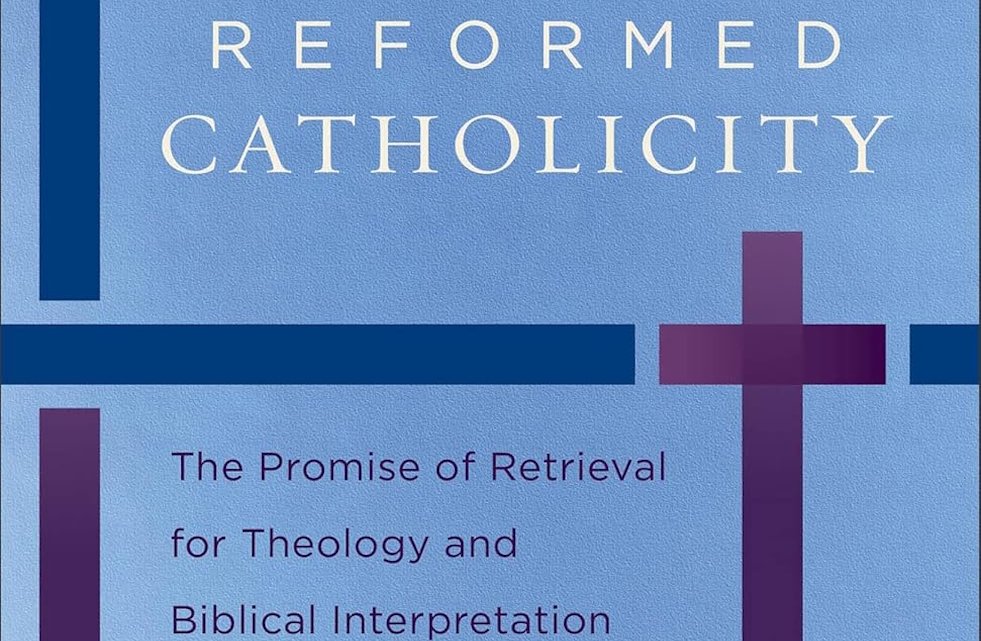
[1] Michael Allen and Scott Swain, Reformed Catholicity: The Promise of Retrieval for Theology and Biblical Interpretation (Grand Rapids: Baker, 2015), 12.
[2] Ibid., “A Rule Reading Reformed: The Role of the Church’s Confession in Biblical Interpretation,” chapter 4 (pp. 95-116).
[3] Michael S. Horton, Elizabeth W. Mburu, and Justin S. Holcomb, eds., Prophet, Priest, and King: Christology in Global Perspective (Zondervan, 2025), xiii-xiv.