Teaching In, With, and Under the Christian Church
Douglas A. Sweeney
Beeson Divinity School
I’ve been working hard recently on a global history of doctrine and, while speaking and writing about its practical significance, thinking once again about what it means to catechize the faithful in families, congregations, and schools in communion with the saints (past and present, near and far). I oppose what some call “the right of private judgment.” I do not think it helpful to encourage individuals to think for themselves in matters of faith and practice, to interpret and hand on the faith once delivered with bespoke idiosyncrasy.[1] “Constructive” doctrinal “moves” often annoy me; I usually find them negligible, sometimes heterodox. Telling students in seminaries to write their own theologies, or statements of faith, is a recipe for trouble, in my estimation. I want pastors and people to conform to the authorized teachings of their churches, to preach, pray, and sing with the rest of Christ’s body “until all of us come to the unity of the faith and of the knowledge of the Son of God, to maturity, to the measure of the full stature of Christ” (Eph. 4:13, NRSV).[2]
In the main, I’m a fan of retrieval theology. It can help us counteract such modernistic practices and ground each other in the best of church history. But in the wrong hands—and without the right guidance—retrieval can also prove to be a bit precious, peculiar, even quirky. It can call forth revisions to Christian faith and practice that separate students from the catholic tradition. It can generate an attitude toward the tradition that is presentist, arrogant. It can cover for the lazy as they cherry-pick the past, taking texts out of context and using them to one-up siblings in the Lord instead of learning together with them humbly, attentively, and teaching God’s people in κοινωνία with the church.
Perhaps a word about the ways in which “retrieval theology” arose in the wake of “constructive theology” will help me make this point. Constructive theology emerged as a movement in the late twentieth century under the leadership of scholars at institutions like Vanderbilt and Harvard Divinity School. These liberal theologians contended that the ancient Christian structures of authority had long since collapsed and that their job as Christian teachers was to let people know, deconstruct the doctrines that were based on old authorities and used to confine and control other people, and retrieve from the ruins choice fragments of Scripture and tradition they could use to build new “models” of God, constructing more liberating pedagogical tools for their people in the present. Constructive theology was invented as a form of liberation theology intended to succeed older biblical, creedal, and confessional theologies.[3]
Retrieval theology is a far more traditional approach to catechesis. Its name was coined recently, partly in response to constructive theology, for a loose set of attitudes, practices, and methods that predate the term itself. While constructive theologians retrieve useful fragments from the margins of church history, employing them to reconstruct liberating understandings of God in pursuit of social justice for the oppressed, retrieval theologians rehabilitate the classic texts of mainstream churches, using them to substantiate contemporary versions of traditional dogmatics. They do so in the manner of the history of ideas, engaging texts and doctrines as transhistorical units from the Bible and tradition, treating them as if they have a life of their own that continues to inform Christian teaching today (a method now passé in academic history departments, where ideas are interpreted primarily in relation to their own historical contexts).[4] But like their liberal colleagues in constructive theology, retrieval theologians often criticize, update, and revise the texts and doctrines they engage from the past. This sets at least their best-known practitioners apart from most older theologians, who taught within the boundaries of their churches and confessions and had less freedom to venture forth on their own. Retrieval theologians often serve quite faithfully in orthodox churches. But their own “constructive moves” in response to the classics are the best-known features of their teaching ministries.[5]
I contend that the doctors or teachers of the church should teach in, with, and under the authority of the church—and resist the temptation to revise and “improve” upon their churches’ instruction on their own or by virtue of their academic guilds. Every once in a while, our churches’ rightful leaders will reach collective decisions to revise our confessions or catechetical tools. But this should not happen in every generation. And when it does occur, the revisions should result from a lengthy time of prayer and discernment by supermajorities of clergy from many different cultures informed by new research, historical developments, and global perspectives on Scripture and tradition.
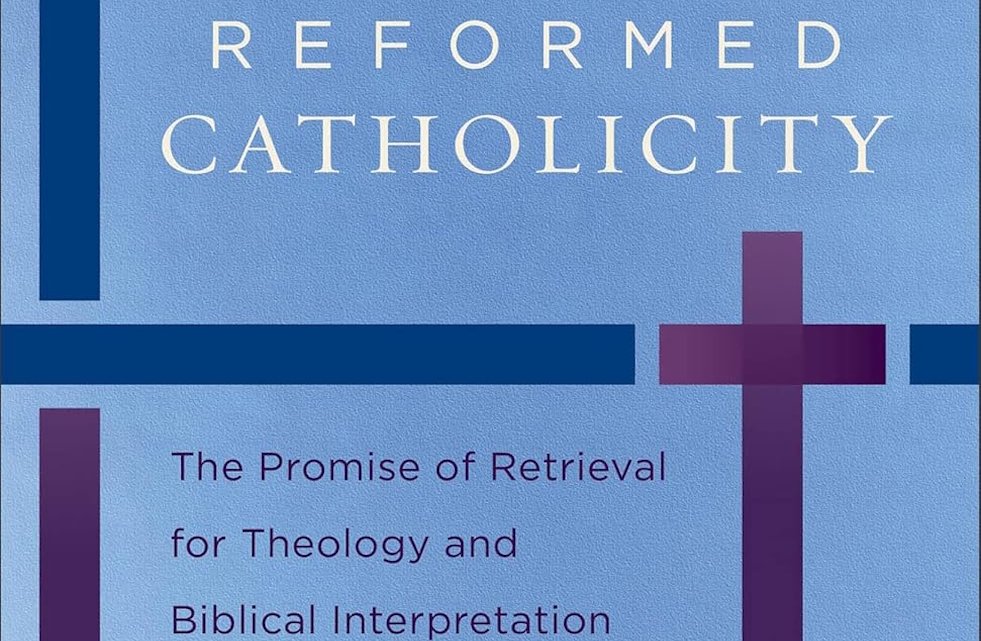
Scott Swain and Michael Allen represent the very best of Reformed-catholic teaching. Reformed Catholicity: The Promise of Retrieval for Theology and Biblical Interpretation is a gem. My prayer is that this book will yield real catholicity among the Reformed—and will rein in the more freewheeling kind of academic work that also goes by the name of retrieval. This latter sort of retrieval is more selective in relation to the catholic tradition, more beholden to contemporary academic trends. It collects small fragments or units from the past and deploys them in support of its own constructive moves. Occasionally, we do need minority Christian voices to call church leaders to account for the sins of their ecclesial communities, and to advocate for changes in church teaching that support reformation. These occasions, though, are rarer than many now think.
For all-too-many leaders, the main event in teaching is one’s own contribution to contemporary discourse. For Allen and Swain, by contrast, the main event in teaching is transmission of the faith in a learned, traditional, orthodox manner, well-informed by creeds and confessions, the rest of the catholic tradition, and the realities we face in the present. May their tribe increase.
[1] This should go without saying, but perhaps it bears repeating: A commitment to the Scripture principle, or to sola scriptura, does not entail the right of private judgment. I agree that the Bible is the only norm that ought to norm our Christian faith and practice. It is best interpreted and applied, however, in communion with the saints.
[2] I unpack these claims in Douglas A. Sweeney, The Substance of Our Faith: Foundations for the History of Christian Doctrine (Grand Rapids: Baker Academic, 2023).
[3] The leading programmatic works in constructive theology are Peter C. Hodgson and Robert H. King, eds., Christian Theology: An Introduction to Its Traditions and Tasks, 2d ed. (Philadelphia: Fortress Press, 1985; orig. ed. 1982); Rebecca S. Chopp and Mark Lewis Taylor, eds., Reconstructing Christian Theology (Minneapolis: Fortress Press, 1994); Serene Jones and Paul Lakeland, eds., Constructive Theology: A Contemporary Approach to Classical Themes, A Project of the Workgroup on Constructive Christian Theology (Minneapolis: Fortress Press, 2005); and Laurel C. Schneider and Stephen G. Ray, Jr., eds., Awake to the Moment: An Introduction to Theology, The Workgroup on Constructive Theology (Louisville, KY: Westminster John Knox Press, 2016).
[4] The “history of ideas” was pioneered by Arthur Lovejoy, who taught at Johns Hopkins University and founded the Journal of the History of Ideas. He laid the intellectual groundwork for this way of making good use of intellectual history in Arthur O. Lovejoy, The Great Chain of Being: A Study of the History of an Idea (Cambridge: Harvard University Press, 1936); and Arthur O. Lovejoy, Essays in the History of Ideas (Baltimore: Johns Hopkins University Press, 1948).
[5] The leading programmatic works in retrieval theology are John Webster, “Theologies of Retrieval,” in The Oxford Handbook of Systematic Theology, ed. John Webster, Kathryn Tanner, and Iain Torrance (New York: Oxford University Press, 2007); and Darren Sarisky, ed., Theologies of Retrieval: An Exploration and Appraisal (London: T & T Clark, 2017).