Reformed Catholicity and the Pastor: Virtues and Postures
Joey Sherrard
Signal Mountain Presbyterian Church, Chattanooga
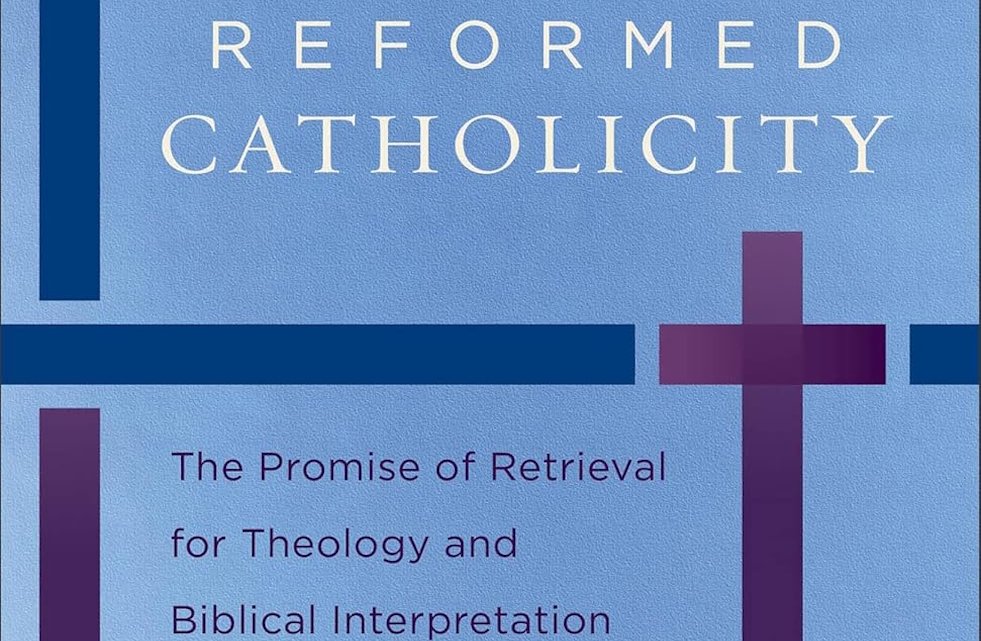
I remember vividly my first encounter with Allen and Swain’s Reformed Catholicity: it was during the final year of my doctoral program, on a train trip from Cambridge back to St. Andrews in midsummer. The volume had just been published, and upon the recommendation of some of my fellow postgraduates I’d picked up a copy to supplement the work of retrieval that I was currently undertaking myself in my thesis-writing. It was a gorgeous British summer day, and my window seat on a largely empty train car provided an especially halcyon setting for theological reflection. But it wasn’t just Northumberland’s sun-drenched landscape that stirred me that afternoon. The project that Allen and Swain expounded was something that I had been searching for myself, a need that was as yet unarticulated and inchoate in my own mind: a careful Reformed account of the place of and need for tradition as a part of God’s ongoing communicative work of upholding and strengthening the Church through His Word. Reformed Catholicity provided all that and more.
I have returned to Reformed Catholicity in the ten years since its publication, but it might go without saying that no other setting has given me quite as idyllic conditions for reflection. Since leaving doctoral work and returning to pastoral ministry, I’ve needed to squeeze subsequent encounters with Reformed Catholicity and texts similar to it into my schedule, fitting them between session meetings, pastoral care appointments, presbytery gatherings, and sermon and teaching preparation. The contrast is indicative of a not insignificant challenge: modern pastoral life often provides adverse conditions for theological work. Which brings me to the rub. How can pastors not just admire the constructive proposal that Allen and Swain present in Reformed Catholicity, but actively participate in it? Which is to say: what are the corresponding postures and virtues that are needed to sustain retrieval within the Church?
Reformed Catholicity begins by identifying ecclesial tradition not merely as creaturely reflection on divine revelation but as the product of the missions of the Triune God. “A Reformed theology of retrieval must help us to perceive the process and products by which the church receives and transmits apostolic teaching not simply as human cultural activities and artifacts but also as fruits of the Spirit” (25). Tradition must be situated within the work of the Father, Son, and Spirit, not as a deracinated work of the human intellect. Thus we can understand tradition as one part of the “creaturely social co-efficient”[1] of the mission of the Spirit.
It is important to emphasize a particular clause in that previous sentence: tradition is one part of the “creaturely social co-efficient” of the mission of the Spirit. Tradition is neither forged nor transmitted in a vacuum. Both persons and institutions are essential elements of the Spirit’s mission. They are essential as those who are objects of that work, caught up in the Spirit’s sanctifying work; but they are also essential as those who are instruments of that work, called and commissioned by God, including participation in the preservation and continuation of tradition: “By the Holy Spirit who dwells within us, guard the good deposit entrusted to you” (2 Timothy 1:14).
In our own times, there is a reflexive impulse to yield that work of preserving and continuing tradition to the academy—professors, universities, and seminaries. But Reformed Catholicity demonstrates that instinct is only half right.[2] Certainly we can affirm with gratitude the fruitful theological work of those who find their primary social location within the institution of the academy, as the citations of Webster, Hütter, and Billings (and indeed Allen and Swain’s authorship) confirm. But alongside those references are also the names of those who worked out their location primarily within the local church—Luther, Calvin, Owen—as well as confessional documents that emerged from Church councils—the French Confession of Faith, the Heidelberg Catechism, and more. The Reformed Catholic project is an ecclesial project that is not only for the Church but one that also emerges from local churches and must be cultivated within local churches, and in what space remains I’d like to consider briefly some virtues and postures that are necessary to sustain that vision.
Pastoral Virtues. If tradition is the ongoing work of the one, holy, catholic, and apostolic church, then there are corresponding pastoral virtues that are necessary to sustain that work. Unity requires pastoral patience in order to negotiate doctrinal disagreement and difference without the kind of hasty dismissiveness that prematurely forecloses upon disagreement (within a local church, a denomination, or even across traditions). Holiness requires pastoral courage to address doctrinal deviance or drift with resolve in an age where theological conviction can be dismissed as dogmatism. Catholicity requires pastoral humility so as to listen charitably to voices from others whose insights are out of step with our own times. And apostolicity requires studiousness so as to train attention upon the foundation of the Scriptures and those who have gone before us in reflecting upon its witness with the intentness which each deserves. Reformed Catholicity requires pastors to cultivate these virtues in order to sustain a lively relationship with tradition.
Traditioned Reasoning. Creeds and confessions serve the Church in numerous ways.[3] But too often they are understood only as boundaries that provide denominational definitions. They are not less than that, but they are much more. Creeds and confessions are expressions of a kind of theological reasoning that is more than simple up or down subscription to a doctrinal standard. The Apostles’ Creed is a form of Trinitarian reasoning that demonstrates the importance of both inseparable operations and the doctrine of appropriations. The Westminster Standards are not merely a doctrinal checklist but also a coherent philosophy of ministry. Reformed Catholicity requires us to move beyond superficial engagement with tradition and instead to immerse ourselves in a form of traditioned reasoning.[4]
Institutional Care. Traditions require institutions in order to prolong their existence. Institutions require tradition to remain faithful to their vocations. But all too often in our anti-institutional age institutional life is at best a grudging duty and at worst a disposable platform. Reformed Catholicity requires a corresponding spirituality of institutional life that emerges from the local church and moves up to a regional gatherings of a presbytery, diocese, or classis all the way to the synod, the assembly, communion, or convention. This is a “spirituality” because these concrete forms of the visible church are themselves the fruit of the Spirit’s work, that “creaturely social co-efficient” of the divine mission. Reformed Catholicity requires us to attend to and participate in the councils of the Church—and relationships, norms, and cultures concomitant with those institutions— as the means by which the Spirit cares for the Church.[5]
Reformed Catholicity represents not just a theological vision for the Church, but a theological vision that emerges from the Church and that must also continue to be sustained and developed from within the Church. Essential to that work is the pastor-theologians who lead local congregations as stewards of the deposit of faith. If that leadership is to be faithful, then the virtues and postures above must accompany that theological vision as it moves into the next decade and beyond.
[1] John Webster, “‘In the Society of God’: Some Principles of Ecclesiology,” God Without Measure: Working Papers in Christian Theology Volume I (London, UK: T&T Clark, 2016), 177. Quoted in Allen and Swain, 34.
[2] In this way, Reformed Catholicity is in tacit agreement with the impulse of the pastor-theologian movement and the desire to return to a more balanced relationship between Church and Academy with respect to theological work. See Gerald Hiestand and Todd Wilson, The Pastor Theologian: Resurrecting an Ancient Vision (Grand Rapids, MI: Zondervan, 2015); Todd Wilson and Gerald Hiestand, eds., Becoming a Pastor Theologian: New Possibilities for Church Leadership (Downers Grove, IL: IVP Academic, 2016).
[3] Carl Trueman suggests the following uses of Creeds and Confessions: delimiting the power of the Church, succinctly summarizing faith, moral guidance, appropriate discrimination between membership and office-holding, representing the ministerial authority of the church, demonstrating expectations for maximal doctrinal competence, relativizing the present, defining traditions in relation to one another, and maintaining corporate unity. See Carl Trueman, Crisis of Confidence: Reclaiming the Historic Faith in a Culture Consumed with Individualism and Identity (Wheaton, IL: Crossway, 2024), 143-173.
[4] See, for example, Kevin J. Vanhoozer, Biblical Authority After Babel: Retrieving the Solas in the Spirit of Mere Protestant Christianity (Grand Rapids, MI: Brazos Press, 2016).
[5] On this, see Gordon T. Smith, Institutional Intelligence: How To Build an Effective Organization (Downers Grove, IL: IVP Academic, 2017); Hugh Heclo, On Thinking Institutionally (Oxford, UK: Oxford University Press, 2008).