One Warning, Two Hopes
N. Gray Sutanto
Reformed Theological Seminary, D.C.
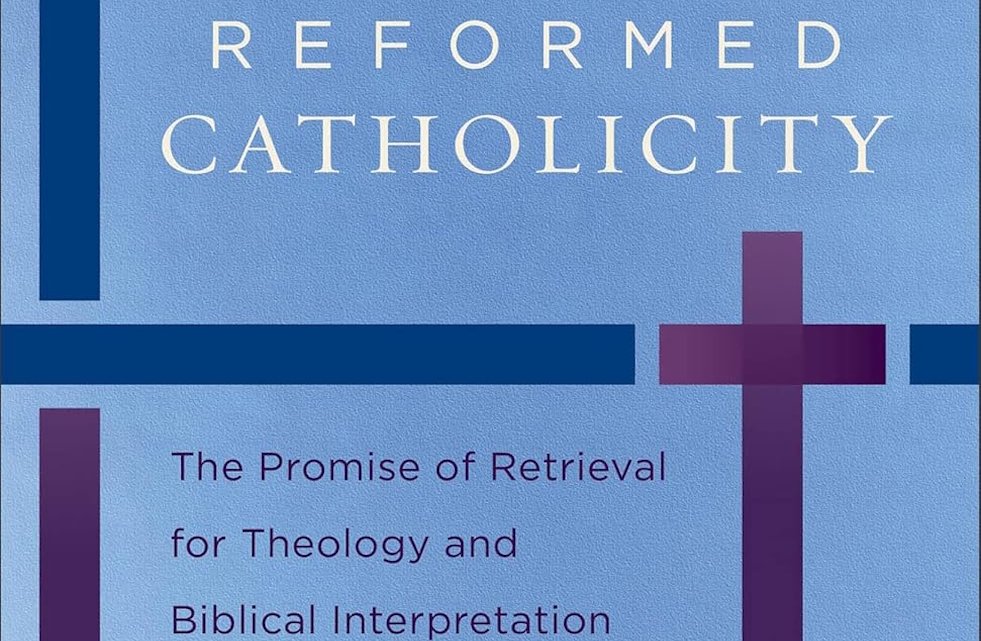
It is hard to overestimate the influence of the slim but tightly argued manifesto, Reformed Catholicity, by my colleagues, Michael Allen and Scott Swain. As I suggested in a review of the work in 2016 for the Journal of Reformed Theology, they have succeeded in offering a distinctly Protestant case for theological retrieval that advances, rather than nullifies, a proper understanding of Scripture as the principium cognoscendi of the church’s doctrinal witness. Alongside attending to the rule of faith and the church as the elicitive principle of theology, Allen and Swain also make their case from a close reading of texts like Psalm 145, Acts 15, and authoritative voices of the ancient, medieval, Reformational, and modern eras. Protestantism does not merely warrant but also mandates a catholic sensibility with respect to the reading of holy Scripture.
Since then, Reformed evangelicals especially have developed a healthy suspicion of Biblicist readings that isolate particular texts from their history of interpretation, and evangelical systematic theology is enjoying a particular kind of revival, nurtured by a realization that attending to the traditions of the church provides an illuminating path forward from some of our present doctrinal and philosophical ills. I suggest that these trajectories are due in no small part to the influence of Allen’s and Swain’s efforts. Complementing this manifesto, Allen and Swain not only provided a companion volume of essays that showcases a Reformed catholic account of the loci of theology (Christian Dogmatics, Baker Academic) but also edit the New Studies in Dogmatics (Zondervan) and the T&T Clark International Theological Commentary series, all of which offer some of the best examples of Protestant catholic sensibilities. As such, I continue to be grateful for this influence, and the reflections I offer below suggest some ways to advance further these paths of reckoning with Scripture and traditioned reflection.
The reflections are threefold: first, a warning, and then two hopes.
As with any work of significance, its influence downstream may not reflect the width, depth, and breadth of the kind of call envisioned in the work. As such, a revisiting of the vision captured here may be useful to those engaged in evangelical theological retrieval. At times, one wonders if there was a subtle narrowing of what ‘catholicity’ means or entails, with talk of there being a (singular) ‘Great Tradition’, rather than a pluriform one – and that ‘tradition’ usually signifies merely a commitment to ‘Christian Platonism’, Thomism, or a ‘Reformed Thomism’, which often functions to mitigate other strands or witnesses. Whereas ‘Reformed catholic’ is meant to be a call to engage the whole of the church’s witness to Scripture, past and present, it could now function as an isolation of one particular strand of that witness. I would suggest that one way we can avoid such a narrowing would be to drop such monikers and opt for traditioned readings and sensibilities (and ‘Reformed catholicity’, in any case, functions well enough to alert one to both the breadth and depth of tradition). I have suggested for a similar sort of move for the neo-Calvinist tradition, resisting the call to reduce it merely to be ‘Kuyperian’, or even ‘Bavinckian’, so as to appreciate the breadth of the whole from Kuyper to, say, G. C. Berkouwer, Herman Dooyeweerd or, in the global context, Shao Kai Tseng. Neo-Calvinism, at its best, is also another permutation of the Reformed catholic sensibility, provided it is viewed also in the round.
In other words, Reformed catholicity should be a field in which multiple viewpoints can fruitfully dialogue and disagree within the context of traditioned discourse. It should encourage, rather than mute, attending to and dialoguing between, say, Aristotelians and Platonists, Franciscans and Dominicans, Bonaventurian, Scotists and Thomists, particular Baptists and Presbyterians, analytic and non-analytic theologians, and so on, while attending to the variegated influences of the whole tradition on each distinct locus of doctrine. Examples abound. Aaron Denlinger’s Omnes in Adam ex pacto Dei, Richard Cross’s Communicatio Idiomatum and Christology and Metaphysics in the 17th century come to mind as exemplary works of historical theology in this regard, whereas John Webster’s and Ian McFarland’s books come to mind in contemporary dogmatics, and Jesse Couenhoven and William Wood produce capably in a more analytic vein. Irenic disagreement and creedal unity, that, is, alertness to the tradition’s unity-and-diversity, rather than myopia, should be the pathway and outcome of a Reformed catholic sensibility.
With that warning in view, my first hope is that a call to be ‘catholic’ should also recognize that the Spirit continues to work in the church today, as much as the past. The same God who guides the church in the past is at work in the whole church at the present. As such, the call of Reformed catholicity should nurture an attitude of gratefulness for the present and the past, recognizing that, though there are major breakthroughs through controversy that led to the formulation of the creeds and confessions of the church, there has been no golden age this side of the fall and before Christ’s return. As John Webster was in the habit of saying – we are tempted to identify all of our ills with Descartes or Kant when it was laid decisively on Adam’s feet. I would thus hope that a catholic sensibility would continue to nurture a vital eagerness of mind regarding the Spirit’s work in the present moment. This was, of course, Herman Bavinck’s emphasis throughout his entire career. In his view, the theologian must be “a child of his own time” and refuse the “easier” route of making “the past one’s own, for this lies at some distance.”[1] (This should also involve attending now to the global context of the church’s witness, and Horton’s, Mburu’s, and Holcomb’s Theology Together series, which explores Christian doctrines in global perspective, comes to mind as especially promising in that regard.)
Finally, I also hope to see a thicker description of doctrinal development, for an account of theological development from a Reformed catholic sensibility seems to be under-explored. Semper reformanda, as applied to doctrine, was more of a 19th century designation rather than a Reformational one (due, actually in part to the influence of Herman Bavinck, as Cameron Clausing’s Theology and History in the Methodology of Herman Bavinck has shown), and it holds a kernel of truth – if Scripture is the norming norm and the church’s witness is a normed norm, there is in principle an account of doctrinal development at our disposal – one that that is neither Biblicist or Roman.
Allen and Swain themselves are exemplary witnesses to the sketch envisioned here. May the influence of Reformed Catholicity continue to increase.
[1] Herman Bavinck, Foremost Problems of Contemporary Dogmatics: On Faith, Knowledge, and the Christian Tradition, trans. Bruce Pass and Gerk de Kok (Bellingham: Lexham Press, 2024), 2.