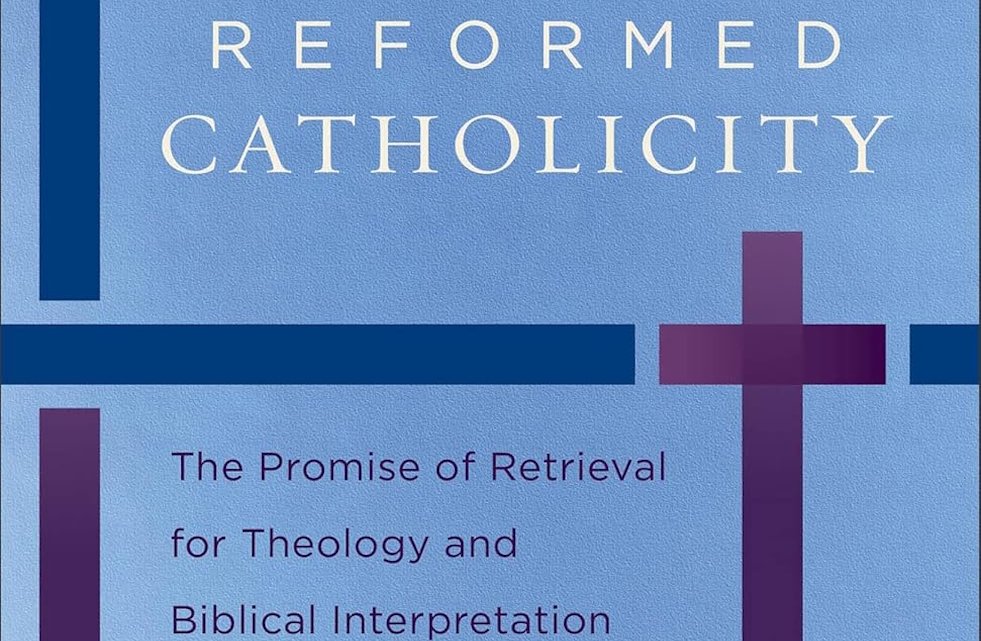
A Tin of Plaudits (and Three Challenges) for a Tenth Anniversary
Kevin J. Vanhoozer
Trinity Evangelical Divinity School
The traditional tenth anniversary gift is tin. It’s an appropriate symbol. Tin is known for its durability and flexibility and used in solder for creating a permanent bond between pieces of metal that would otherwise be disconnected. So, I suggest, is the concept of Reformed catholicity, a notion that has connected past to present and endured for a decade.
Protestants rightly protest their unfortunate caricature as rugged individuals who have a divine right to interpret the Bible for themselves. Scott Swain and Mike Allen did not invent the term “Reformed catholicity,” but in retrieving it they have made a significant step forward in addressing what Christian Smith has termed the problem generated by the naïve biblicism of such hermeneutical individualism: pervasive interpretive pluralism.[1]
Whereas Roman Catholics put to use their own ressourcement energies recovering sacramental theology, Reformed catholicity recovers the theology of the word, namely, sola scriptura. It is a bold and exciting venture. Protestants shouldn’t retrieve just because everyone else is combing the beach with metal-detectors looking for precious booty. Allen and Swain are on stronger ground when they give a properly dogmatic account for retrieving catholicity: the “deepest warrants for a program of retrieval are trinitarian and christological” (18).
I have been an enthusiastic supporter of this proposal since Baker Academic first solicited my opinion as to whether or not to publish it and endorsement (which I was happy to provide). In a certain sense, “Reformed catholicity” is the answer to my lifelong question, “What does it mean to be biblical?” Indeed, it has led me to modify my own understanding of “first theology,” which I now think involves not only God and Scripture, but also the church.
What, then, is Reformed catholicity? It is an attempt to be biblical (and maintain sola scriptura) by being ecclesial, that is, by interpreting Scripture in, for, and with the communion of saints. The appeal for reading in ecclesial context is not a limp postliberal appeal to the authority of interpretive communities. Rather, it is a robust Protestant appeal to the mission the Holy Spirit, the Spirit of truth, deputized by the risen Christ to enable the church rightly to hear and receive the Word and to minister biblical understanding – the “proper effects of his pedagogical grace” (45).
One might see sola scriptura as Reformed catholicity’s formal principle and the ecumenical creeds and Reformed confessions as its material principle, with semper reformanda serving as the explanation of the order in which the two principles properly relate. The catholic tradition frames and nourishes Reformed theology; Reformed theology re-centers and furthers the catholic tradition; the authoritative Scriptures simultaneously stretch and delimit the contours of catholicity.
In his “Afterword,” Todd Billings challenges catholic-Reformed scholars to engage with the Theological Interpretation of Scripture (TIS). I think Allen and Swain are already doing that. Indeed, Reformed catholicity sets out a distinctly Protestant approach to TIS, a way of integrating the Word of God with the Spirit of God and the Church of God.
My own work is replete with harbingers of Reformed catholicity, but lacks the close conceptual and dogmatic analyses that Allen and Swain provide. In The Drama of Doctrine, I identified the canon as the divinely approved means by which God exercises his authority in, and over, the church, adding that “It is primarily in the church’s reading of Scripture that the risen Christ, through his Spirit, exercises his lordship over the church.”[2] Theology, I said, is a function of two principles: the canonical, which acknowledges Scripture as God’s authoritative word, and the catholic, namely, the acknowledgement that no one interpretation of Christianity – no single contextualization – is equal to or can replace the canon. We need the whole people of God, extended through space and time, to grasp the fullness of God’s word: “The gospel designates a determinate word; catholicity, the scope of its reception.”[3] Or, as I stated it a few years later in another book: “There is therefore now no condemnation for those who wholeheartedly affirm both canonicity (the supreme authority of Scripture as a rule for Christian faith and life) and catholicity (the divinely appointed nurturing role of the church and her consensual tradition).”[4] I said similar things in Biblical Authority after Babel: “The best Protestants are catholic Protestants – people centered on the gospel but also alert to how the gospel has been faithfully received across cultures and centuries.”[5]
I see three challenges ahead for those who, like me, wish to pursue something akin to Reformed catholicity as an alternative to either (individualist) biblicism, (communitarian) traditionalism, or Roman Catholicism.
The first challenge is to justify, then specify, the force of the “Reformed” qualifier of a term that means universal. “Which catholicity?” and “Whose catholicity?” are valid questions. A case in point: the Lutheran theologians Carl Braaten and Robert Jenson produced their own manifesto, The Catholicity of the Reformation, twenty years before Reformed Catholicity.[6] They also co-founded the Center for Catholic and Evangelical Theology in 1991. More recently, the Center for Baptist Renewal has produced a manifesto for Evangelical Baptist Catholicity.[7] What, if anything, is the difference between the Baptist, Lutheran, and Evangelical qualifications of catholicity and the Reformed catholicity advocated by Allen and Swain? The follow-up question is whether Reformed theologians agree amongst themselves about what catholicity means, and entails.[8]
Given the centrality of sola scriptura, a second challenge is to articulate a Reformed understanding of Scripture’s literal sense. Erik Lundeen has recently shown that, while the Reformers agreed that the literal sense alone could establish doctrine, they nevertheless disagreed as to what actually constitutes the literal sense.[9] My own “reformed catholic” proposal (yes, I use the term) is that it involves loving attention to the letter of the text, an acknowledgement of divine authorship and of canonical context, a focus on Christ-centered redemptive history, and a willingness to have one’s interpretation corrected by the text.[10]
A third challenge follows from the two preceding. It’s the perennial problem of providing a non-circular epistemic criterion, or rule, for determining whose reading of the Bible’s literal sense counts as a legitimate instance of true catholicity. The South African theologian Dirk J. Smit calls this the “deep contradiction” of Reformed theology.[11] It is generated by the claim that, on the one hand, Scripture alone is the supreme authority, and by the acknowledgement that we have no access to a supreme authoritative arbiter that could determine which of the many possible interpretations is the correct one, on the other.
I for one do not believe that Reformed catholicity requires what Yuval Harari calls the fantasy of an infallible interpreter.[12] Harari thinks the world had to wait for modern science before it had a “self-correcting mechanism,” namely, the willingness to submit theories to any number of empirical tests. I submit, however, that Reformed catholicity may indeed incorporate such a self-correcting mechanism, when right-minded and right-hearted readers, in prayerful humility, are open to the movement of the Spirit, even (especially!) when it goes against settled opinion, and when they commit to engage in earnest exegetical conversation: “For it has seemed good to the Holy Spirit and to us…” (Acts 15:26).
[1] See Christian Smith, The Bible Made Impossible: Why Biblicism Is Not a Truly Evangelical Reading of Scripture (Grand Rapids: Brazos, 2011).
[2] Kevin J. Vanhoozer, The Drama of Doctrine: A Canonical-Linguistic Approach to Christian Theology (Louisville: Westminster John Knox, 2005), 124.
[3] Ibid, 27.
[4] Kevin J. Vanhoozer, Hearers & Doers: A Pastor’s Guide to Making Disciples Through Scripture and Doctrine (Bellingham, WA: Lexham Press, 2019), 201.
[5] Kevin J. Vanhoozer, Biblical Authority after Babel: Retrieving the Solas in the Spirit of Mere Protestant Christianity (Grand Rapids: Brazos, 2016), 199.
[6] Carl E. Braaten and Robert W. Jenson, eds., The Catholicity of the Reformation (Grand Rapids: Eerdmans, 1996).
[7] https://www.centerforbaptistrenewal.com/evangelical-baptist-catholicity-a-manifesto (accessed Jan. 30, 2025).
[8] See Willem van Vlastuin, Catholic Today: A Reformed Conversation about Catholicity (Göttingen: Vandenhoeck & Ruprecht, 2020).
[9] Erik Lundeen, The Reformation of the Literal: Prophecy and the Senses of Scripture in Early Modern Europe (London and New York: T&T Clark, 2025).
[10] Kevin J. Vanhoozer, Mere Christian Hermeneutics: Transfiguring What it Means to Read the Bible Theologically (Grand Rapids: Zondervan, 2024), 181.
[11] Dirk J. Smit, Essays on Being Reformed: Collected Essays 3 (Stellenbosch: Sun Media, 2009), 306.
[12] Yuval Noah Harari, Nexus: A Brief History of Information Networks from the Stone Age to AI (New York: Random House, 2024), 71.